Showing posts with label CIS-60. Show all posts

14 October 2015

CIS-60: just carriers


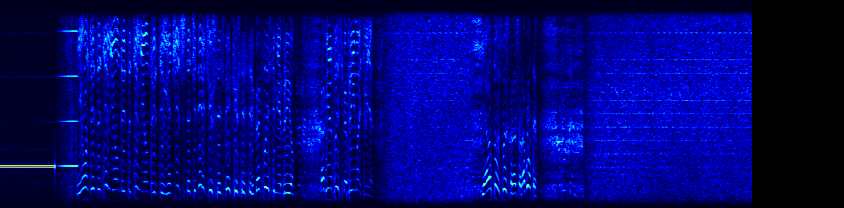
carriers only, w/out modulation, in this CIS-60 sample recordered at 14202.0 KHz on USB a fews days ago (added here beacuse of the signal strength). In that same listening-session, after the tone at ~850 Hz I listened to a short speech (in Russian language), a radio-check requested by the operator behind that CIS-60 (chizh-64) and directed the other side of the peer (neon-37): "neon 37 here chizh 64, how do you read me. Work, work" followed by data sending in CIS-60 data mode (translation from Russian by my good friend KarapuZ).
All recording files are available.


1 October 2015

CIS-60 30Bd, π/2-DBPSK

this CIS OFDM 60-tone modem, probably also it belonging to the CIS HDR family, was heard on 29 September at 0600z on 14259.0 KHz on USB. It exhibits a rather intriguing waveform:

1) manipulation speed is 30Bd and channel step 44.4Hz (Pic. 1), values are reasonably approximated since the signal was not sampled at its native frequency (look at "k" parameters);
Pic. 1

2) modulation format is DBPSK with these features: 
a) a service-tone (w/out modulation) is sent each 3 symbols in all (!) the carriers
b) 24 tones (say black-carriers) have π/2-DBPSK (Pic. 2);
c) 24 tones (say blue-carriers) have the same π/2-DBPSK modulation but with the evidence of the service tone (Pc. 3);
d) 12 tones (say red-carriers) have regular DBPSK (Pic. 4).

Pic. 2 - 24 (black) carriers: π/2-DBPSK
Pic. 3 - 24 (blue) carriers: π/2-DBPSK and service-tone
Pic. 4 -  12 (red) carriers: DBPSK
Pic.5 - phase angles in black/blue and red carriers

By writing the 60 coloured carriers in a 10x6 array, it's interesting to note that they are are arranged in a sort of diagonals format (Pic. 6):

Pic. 6 - carriers arrangement

About the ACF value, it is 200 ms, that makes 6 symbols although the real measure is 202.3 (Pic. 7) ms but you must consider that the signal is not perfectly in-frequency: infact the measured baudrate is not the expected 30.0 Bd but rather 29.9 Bd. Anyway, calculating the mathematical proportion:

(symbols-per-second : 1000) = (symbols : ACF)
(29.9 : 1000) = (x : 202.3) ; x = 6.04 

you get 6.04 symbols per frame. Then, given the exact 30Bd baudrate, I think the real ACF is 200. A further evidence in this direction is that just each 6 symbols the service-tone occupies the same position (Pic. 8).

Pic. 7 - 6 symbols ACF (200 ms)
Pic. 8 - each 6 symbols causes 200 ms ACF

30 September 2015

CISwitching...


September, 30 at 0711z on 15812.0 KHz on USB: on-the-fly switch from CIS-45 to CIS-60, both belonging to HDR (High Data Rate) family modem. Maybe tests or fast (auto) adatpion to the channel conditions ?

19 September 2015

about π/4 DQPSK modulation (here in CIS-60 30Bd)

looking deeper at CIS-60 signal reported in the previous post, the relative constellation changes in a symbol by symbol way but always exhibiting a 4-ary constellation although absolute constellation in each-1 mode looks like a PSK-8 modulation. This condition is called "π/4 DQPSK modulation" (Pic. 1).
Pic. 1
The π/4 DQPSK modulation format uses two QPSK constellations offset by 45 degrees (π/4 radians) and transitions occur from one constellation to the other, making the illusion of a PSK-8 modulation (Pic. 2). This guarantees that there is always a change in phase at each symbol, making clock recovery easier. The data is encoded in the magnitude and direction of the phase shift, not in the absolute position on the constellation. One advantage of π/4 DQPSK is that the signal trajectory does not pass through the origin, thus simplifying transmitter design.


Pic. 2 - we see PSK-8 in absolute constellation since the π/4 DQPSK modulation format uses two QPSK constellations offset by 45 degrees and transitions occur from one constellation to the other.
I want mean  that we see two 45 deg shifted QPSK (in relative) constellations:
- the one each 1, 3, 5,... symbols
- the other each 2,4,6,.. symbols
and this also influences the pattern that we see in absolute constellation.

In order to be safe about the main modulation (4 or 8-ary) used in this waveform, I highlighted a single channel from the CIS-60 signal (Pic. 3): if it was a clean QPSK or PSK-8 modulation then we should see three harmonics  in the fourth power while there are only two and this outstands a behavior of a π/4 DQPSK modulation (and OQPSK too). 
Now, looking at the phase plane of this channel, notice that the absolute constellation (Diff-0) exhibits 8-ary, BUT, as said above, there is no transition paths through the center (as in case of a clear PSK-8!) and that the relative constellation (Diff-1) looks like QPSK but 90 degrees rotated: this suggest the π/4 DQPSK modulation.
 
Pic. 3

By the way, the π/4 DQPSK modulation format is also used in CIS-45 v2 HDR modem (Pic. 4).

Pic. 4

The channel-by-channel analysis with the SA phase-plane method should be performed on all the channels, but it requires very good signals/recordings and a lot of time; anyway all the channels have been examintaed using SA OFDM module always getting the same  constellations shown in Pic. 2.

14 August 2015

CIS-60 idle


The signal, heard on August 12.08 16810.0 KHz on USB, is a variant of the CIS-60 idle, possibly for test or adjustment/calibration purposes. CIS-60 waveform is analyzed here http://signals.radioscanner.ru/base/signal231/  and here CIS-60 in this blog.
I say a "variant" since a similar test signal is also mentioned in radioscanner.ru at that same address, but in my sample, at a first glance, looking at its sonogram the 60 tones seem to be housed in what looks like a curious 40+20 (+1 pilot tone) grid: although all the tones are not modulated, the top 20 tones (41-60) appear in some way shifted with respect to the lower ones (1-40). 
After resampled the signal at 8888.88 Hz (shift * 200), from 1-40 tone to tone there is a 180º phase shift in the relative constellation, but,from tone 40 to tone 41 there is no variation (Pic. 1). As AngazU too suggests, this could point to a different phase of the top 20 tones during the initial generation of the signal. Moreover, looking at the OFDM parameters (Pic. 2), there is a different baudrate in (at least this) test mode (30Bd) with respect to the usual traffic mode (35.5Bd). BTW, a 30Bd traffic mode was also noted.
Recordings available on request.

Pic.1 - phase variation

Pic. 2 - OFDM parameters

29 May 2015

CIS-60 HDR modem 35.5 Bd, π/8-DPSK8


CIS-60 is one of the Russian OFDM HDR (High Data Rate) Modem modes,  it uses 60 data carriers and 1 pilot carrier located 3300 Hz from dial frequency, as usual in CIS HDR modem series. According to my logs, CIS-60 comes in two waveforms (I have logged both the twos):
- Baudrate 30, modulation QPSK
- Baudrate 35.5, modulation π/8-DPSK8
in both the cases the carriers are 44.5 Hz spaced and the signals spreads a 2800 Hz bandwidth. Sometimes you could hear operators chatting (in voice) followed by a waveform switch, i.e. from DPSK-4 to DPSK-8: I do not know if it's for tests purposes or for some other reason. The original signal has been resampled to 8888.8 Hz.


radioscanner.ru reports CIS-60 DPSK-8 waveform here:
http://signals.radioscanner.ru/base/signal231/ 

25 March 2015

CIS-60 HDR modem 30 Bd, π/4-DQPSK

heard this morning on 14259.0 USB at 0720z, this is the second mode of the so-called "CIS-60" family: a CIS/Russian  OFDM HDR modem 60-tones + 1 pilot. 
Unlike the transmission heard yesterday, and reported in another post, the manipulation speed is 30 Baud per channel and modulation in channels is π/4-DQPSK; the channel separations remains at 44.44 hertz. I just would remember that the CIS-60 first mode is a π/8-DQPSK-8, 35.5 Baud mode.

Bandwidth: ~ 3000 Hz
Number of channels: 60 + 1 pilot tone (~ 3300 Hertz)
Manipulation in the channels: π/4-DQPSK
Step between channels (frequency net/grid): 44.44 Hz
Manipulation speed (Baud rate): 30