The transmission has been copied on 7788.0KHz/USB and consists of an emails exchange between an Algerian Navy ship (Rais Hamidou) and the Headquarter of French Navy in Toulon (COMTOULON). Messaging is performed by Stanag-5066 CFTP protocol (Internet Messaging over ARQ) in half-duplex mode, carried by MIL 188-110A serial waveform (Fig. 1). Link is not negotiated/established using ALE but by means of voice-comms between the operators.
 |
| Fig. 1 |
Basically, CFTP (Compressed File Transfer Protocol), sometimes referred to as BFEM (Battle Force Email), is a file transfer mechanism and STANAG 5066 Annex F defines its use for message transfer. CFTP is specified to work over a point to point network - that is, to communicate between a pair of nodes, with both nodes able to send data.
 |
| Fig. 2 - S5066 bitstream synched on D_PDU SYNC |
The CFTP protocol shall not be used for Formal or High Grade Military Messaging (military orders) and may be used for informal interpersonal e-mail only; anyway, I'm interested in the way the "boxes" travel and not in their contents.
In operation, when an email message is received at a S-5066 node (port 5066 on localhost), it is placed in an incoming mail folder (mail spool directory). The CFTP client, also called the Delivery Agent, removes the mail from this incoming folder and compresses the message and information about the message, e.g. size, id, recipients, etc. into a file which is then transferred to the destination node using the Edition-1 Basic File Transfer Protocol (BFTPv1) PDUs which are then incapsulated into Data PDUs (Fig. 2) before to be sent to the HF modem. The structure of BFTPv1 PDU is shown in Fig. 3, along with the g-zipped file from the copied transmission.
 |
| Fig. 3 - BFTPv1 Protocol Data Unit Structure |
Client Delivery confirmation is provided by the receiving node using the Message Acknowledgement, sent as the body-part (!) of a CFTP/RCOPv1 PDU:
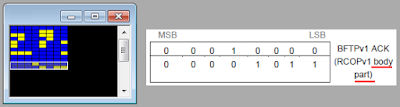 |
| Fig. 4 - BFTPv1 Message Acknowledgement Structure |
The CFTP mail-file is built as specified in paragraph "F.14.6 Detailed Description of CFTP, ANNEX F to STANAG 5066 Edition 3":
 |
| Fig. 5 - CFTP email-file |
Below, some details about the two STANAG-5066 nodes in the play:
node: EMMA046
tactical callsign: PI (papa india)
S-5066 address: 006.014.100.001 (official NATO S-5066 address)
email domain: toulon.frenchnavy.fr
host: EMMA046 (Rockliffe SMTPRA 4.2.4)
site: COMTOULON Toulon, French Navy
node: BDSL472
tactical callsign: BD (bravo delta)
S-5066 address: 010.000.000.001
(near-official NATO S-5066 address since the 010.001 block is assigned to Algeria)
email domain: rh.raishamidou.dz
host: BDSL472 (Windows NT 6.1; WOW64; rv:24.0)
site: corvette "Rais Hamidou", Algerian Navy
The other labels in the emails headers offer some other informations:
2) the "WOW64" in user-agent string means a 32-bit version of Internet Explorer is running on a 64-bit processor: so the ship is equipped with a 64-bit PC running Windows7 or Windows Server 7 (Windows NT 6.1)
By the way, it's interesting to note in the curious behavior of one of the two 188-110A modems and precisely the one at the ship side of the link: the initial 2600Hz tone-beep is maintained for the duration of each single transmission time and does not affect the correct demodulation of the signal (Fig. 3)
 |
| Fig. 3 |
Although 188-110A is an auto-baud waveform, operators negotiate the speed and interleaver which will be used during the initial phase of the data transmission: this leads to think to inter-operability or deployment tests.
(due to confidentiality, wav file and bitstream are not avalilable. Sorry.)


