
4 August 2020 update
some frequency, same timing, and same 511-bit sequence but the speed has switched to 50Bd (shift remains unchanged, 500Hz):
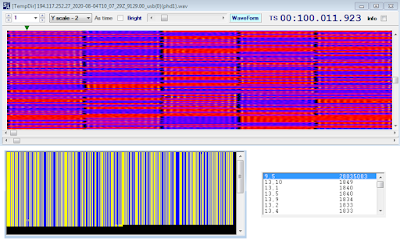
It's to notice that the 511-bit sequence is obtained using the seed s=[0 0 0 0 0 0 0 0 1] and transmitting the output in opposite polarity (i.e., inverting the polarity of the demodulated sequence we get the exact sequence generated with seed s=[0 0 0 0 0 0 0 0 1]):
2 August 2020
Just to log interesting 100Bd/500 FSK-2 transmissions found on 9130 KHz (CF). Data sent consist of a repeated 511-bit pseudo-random sequence which is generated by the polynomial x^9+x^5+1 (Fig. 1); likely that sequence is used when no data to transmit is available or to mantain sync between transmitting and receive modem (see also ITU Recommendation O.153 [1]). Since the 100Bd/500Hz waveform is used in several systems, it's difficult to state the source; anyway, it's to notice that x^9+x^5+1 sequences (PRBS9) are also used in CIS-12 and more generally in T-230 family devices.
some frequency, same timing, and same 511-bit sequence but the speed has switched to 50Bd (shift remains unchanged, 500Hz):

It's to notice that the 511-bit sequence is obtained using the seed s=[0 0 0 0 0 0 0 0 1] and transmitting the output in opposite polarity (i.e., inverting the polarity of the demodulated sequence we get the exact sequence generated with seed s=[0 0 0 0 0 0 0 0 1]):
 |
| up: LFSR sequence when seed = [0 0 0 0 0 0 0 0 1], down: received sequence after reversing the polarity |
2 August 2020
Just to log interesting 100Bd/500 FSK-2 transmissions found on 9130 KHz (CF). Data sent consist of a repeated 511-bit pseudo-random sequence which is generated by the polynomial x^9+x^5+1 (Fig. 1); likely that sequence is used when no data to transmit is available or to mantain sync between transmitting and receive modem (see also ITU Recommendation O.153 [1]). Since the 100Bd/500Hz waveform is used in several systems, it's difficult to state the source; anyway, it's to notice that x^9+x^5+1 sequences (PRBS9) are also used in CIS-12 and more generally in T-230 family devices.
 |
| Fig. 1 - the 511-bit pseudo-random sequence |
Looking at the two FSK tones, it seems that they preserve their phase after each switch-over (Fig. 2). By the way: F1 = 753.87 Hz (1:0.001326479), F2 = 1253.68 Hz (2:0.001595299), dF = 499.81 Hz.
 |
| Fig. 2 |
I followed the transmissions for some days, they usually take place on weekdays at 0943 and stop at 1100 (UTC times). I ran several TDoA attempts and results point to the Moscow area, unfortunately they do not exactly agree.
 |
| Fig. 3 - start stop period |
 |
| Fig. 4 - some of the TDoA results |


