Showing posts with label CIS-50/500. Show all posts

23 June 2020

CIS Navy 50Bd/500 FSK 136 bit (T-600-136)

Yet another 50Bd/500 FSK transmission, this time recorded monday morning on 14704.0 KHz (cf) around 1340Z and almost surely sourced by the CIS Navy T600 system (typical shifts: 200, 250, and 500 Hz): given the 136-bit length frames this waveform is also known as "T600-136".

Fig. 1 - FSK parameters
Note that the full transmission period is 544-bit length, i.e. 4 x 136-bit frames. Indeed, from a quick examination of the demodulated bitstream (Fig. 2), it is easy to see that it's composed of blocks of four repeated frames, probably to add redundancy to the system.

Fig. 2 - CIS-Ny 50Bd/500 bitstream (136-bit frames)
 
The same 136-bit framing is also used in the CIS-Ny 50Bd/250 FSK, still from a T600 system (Fig. 3): these two waveforms seem to be used to carry the same "type" of messages unlike the CIS-Ny 50Bd/200 FSK which shows a different structure of the frames (70-bit Message Indicator, 4:3 ratio,...) and it's mainly used for fleet broadcast.

Fig. 3 - CIS-Ny 50Bd/250 bitstream (136-bit frames)

Although the shift is a multiple of the manipulation speed, the two tones do not preserve their phase (Fig. 4).
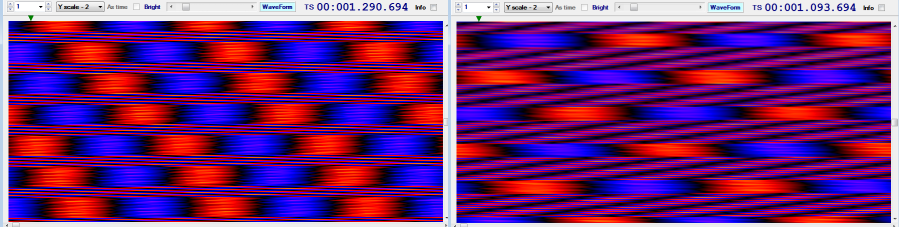
Fig. 4 - CIS-Ny 50Bd/500 tones

14 June 2020

50Bd/500 FSK (likely CIS Gov/Mil)

update

My friend cryptomaster (thanks) confirmed the user (CIS networks) and he also pointed out that the 128-bit sequence is actually a 64-bit sequence that is transmitted in opposite polarity:
1111101111001110101100001011100011011010010001001100101010000001
0000010000110001010011110100011100100101101110110011010101111110


As well as the central part of the message which is the same 64-bit sequence (here 13-bit shifted) but with one bit in error:

0010101000000111110111100111010110000101110001101101001000100110
1101010111111000001000011000101001111010001110010010110111011000


11 June 2020

Unid (likely CIS) 50Bd/500 FSK message recorded on 12221 KHz (cf) at 1035z using the KiwiSDR "nsk" located near Novosibirsk, Russia. Notice the sequences generated by the polynomials x^7 + x^5 +x + 1 (128 bytes length) and x^5 + x^4 + x + 1 (Fig. 1).

Fig. 1 - the two LFSR sequences
Although the shift is an integer multiple of the speed, the two FSK tones do not preserve their phases (Fig. 2).

Fig. 2 - phases of the two FSK tones
https://yadi.sk/d/mZiO7oRcHtQ5-Q

8 September 2017

K4MT/NT9P Net, Russian Intel/Diplo (M42b)


K4MT/NT9P network, also known as Enigma designator M42b, is a quite common Russian Intel/Diplo network which uses both CW-Morse and FSK 50Bd/500.

Fig. 1
In this recording, FSK follows a CW call "NT9P NT9P NT9P DE K4MT K4MT K" and in turn it's followed by a "CFM QRU K" request: most likely the CW is used for setup or operators chat. The FSK is a Baudot 5FG coded stream using a preamble and 7-bit period (fig. 2):

Fig. 2
note the markers at every group of 50 x 5FGs (Fig. 3):
Fig. 3


30 March 2017

Baudot FSK 50Bd/500 (unid Rus Gov/Mil)

Some day ago, me and my friend KarapuZ were talking about some asynchronous 500 Hz shift FSK-2 signals and the way to get a meaningful decoding from the demodulator of SA. The first step is the removal of the START/STOP bits according to the size of the data field  (ie 5, 6, 7 or 8 bits) and then try different alphabet codes in turn, until you find one that produces an output that makes a sense. 
The analyzed signals have a shift of 500 Hz, a manipulation speed of 50 Baud and a 5-bit size data field. 
Once removed the START/STOP bits, we tried the 5-38 code (1 start bit, 1.5 stop bits, the good old Baudot), as KarapuZ advised, and we got groups of 5 LTs (or 5 FGs ?). The used procedure, and the results, are shown below.
Fig.1
Fig.2
Groups of 5 LTs is a "format" that is frequently used by several Military and Governative Agencies so in the absence of other evidence it's a bit difficult to identify the source, although there are good chances in favour of  CIS/Russian users.