30 June 2020

CIS-75 FSK 75Bd/250 (3): 126-bit LFSR sequence

(for background, read all the posts of this topic)
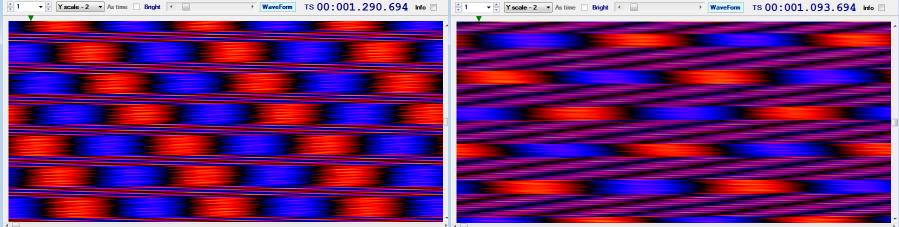
Russ-Mil CIS-75 75Bd/250 FSK system spotted this morning on 15832.0 KHz (cf). After differential decoding, the bitstream shows a clear 385-bit period and a 126-bit pseudo random sequence, generated by the polynomial x^7+x^6+1, which is inserted in the data stream probably to re-sync the receive modem among the messages, note that the sequence has one bit in error (maybe planned?):

111110111110011110101110000110111010011000101011000001011110001
110110110010010100100001001110010110100010001100110101010000000

Fig. 1 - 126-bit pseudorandom sequences
Fig.2 - the synched stream
It's interesting to note that in previous CIS-75 recordings, we saw the use of a 128-bit (!) length pseudo-random sequence transmitted in positive and negative polarity: those sequences are easily identifiable by inspecting the stream with a window, coincidentally, 385-bit wide.
By the way, the same polynomial x^7+x^6+1 is also used by the French-Ny in their 50Bd/850 FSK fleet broadcast as one of the two stream LFSR delimiters [1].  


29 June 2020

unid 40.4Bd/800 FSK & FSK/Morse

6800.0 KHz (cf): unusual 40.4Bd/800 FSK long time reversals then into FSK/Morse "UUG4 de UTN7 ZC GB 73 SK" and off-air. Most likely a CIS network.
 
 
Comments are welcome 😄

23 June 2020

CIS Navy 50Bd/500 FSK 136 bit (T-600-136)

Yet another 50Bd/500 FSK transmission, this time recorded monday morning on 14704.0 KHz (cf) around 1340Z and almost surely sourced by the CIS Navy T600 system (typical shifts: 200, 250, and 500 Hz): given the 136-bit length frames this waveform is also known as "T600-136".

Fig. 1 - FSK parameters
Note that the full transmission period is 544-bit length, i.e. 4 x 136-bit frames. Indeed, from a quick examination of the demodulated bitstream (Fig. 2), it is easy to see that it's composed of blocks of four repeated frames, probably to add redundancy to the system.

Fig. 2 - CIS-Ny 50Bd/500 bitstream (136-bit frames)
 
The same 136-bit framing is also used in the CIS-Ny 50Bd/250 FSK, still from a T600 system (Fig. 3): these two waveforms seem to be used to carry the same "type" of messages unlike the CIS-Ny 50Bd/200 FSK which shows a different structure of the frames (70-bit Message Indicator, 4:3 ratio,...) and it's mainly used for fleet broadcast.

Fig. 3 - CIS-Ny 50Bd/250 bitstream (136-bit frames)

Although the shift is a multiple of the manipulation speed, the two tones do not preserve their phase (Fig. 4).

Fig. 4 - CIS-Ny 50Bd/500 tones

14 June 2020

50Bd/500 FSK (likely CIS Gov/Mil)

update

My friend cryptomaster (thanks) confirmed the user (CIS networks) and he also pointed out that the 128-bit sequence is actually a 64-bit sequence that is transmitted in opposite polarity:
1111101111001110101100001011100011011010010001001100101010000001
0000010000110001010011110100011100100101101110110011010101111110


As well as the central part of the message which is the same 64-bit sequence (here 13-bit shifted) but with one bit in error:

0010101000000111110111100111010110000101110001101101001000100110
1101010111111000001000011000101001111010001110010010110111011000


11 June 2020

Unid (likely CIS) 50Bd/500 FSK message recorded on 12221 KHz (cf) at 1035z using the KiwiSDR "nsk" located near Novosibirsk, Russia. Notice the sequences generated by the polynomials x^7 + x^5 +x + 1 (128 bytes length) and x^5 + x^4 + x + 1 (Fig. 1).

Fig. 1 - the two LFSR sequences
Although the shift is an integer multiple of the speed, the two FSK tones do not preserve their phases (Fig. 2).

Fig. 2 - phases of the two FSK tones
https://yadi.sk/d/mZiO7oRcHtQ5-Q

5 June 2020

Saab Grintek MHF-50 "preamble" variant


Saab Grintek MHF-50 variant recorded on 8603.0 KHz/USB using the KiwiSDR located at TWR Kempton Park, South Africa: notice that 8603.0 Khz is believed to be one of working channels used by South African Navy.
The signal has a kind of "preamble" (Figs. 1,2) which is followed by the usual multimode waveform. This preamble consists of a short 75Bd/170 FSK
010100101001010010100101001010010100101001010010100101001010010100101
followed by a 120 sec long 1622 Hz tone which exhibits interesting markers each 12 & 1 seconds maybe to serve sync purposes.

Fig.1
Fig.2
As said, the preamble is followed by the well known multimode waveform (Figs. 3,4) consisting of 54.4Bd/390 FSK and 54.4Bd/65 MFSK-33 with the characteristic 3 tones signaling the EOM.

Fig. 3
Fig. 4

6 June 2020 update


As noted by my friend KarapuZ, the 75Bd/170 FSK segment 
010100101001010010100101001010010100101001010010100101001010010100101
can be successfully descrambled using the polynomial x^8 + x^6 + x + 1; maybe it serves sync purposes for the following MFSK decoder. It's interesting to note that the same polynomial is used in CIS-75 waveform.


It's supposed that some frequencies (4346, 6504, 8580, 12982, ...) are either channel markers, propagation markers and/or FAB channels and some other (4245, 6407, 6493, 8603, ...) are traffic channels; anyway, it seems that they carry different patterns.