21 June 2023

unid 15.66Bd/120 FSK system

This is a new FSK signal for me that can be heard starting mid-morning, at least on that frequency, with a good SNR using a KiwiSDR located in the UK [1]. Coming to the signal' main parameters, the FSK central frequency is 6938.55 KHz, 120 Hz shift and an apparently(!) keying speed of 31 Baud (or bps, since the FSK mode): Figure 1 show these values.

Fig. 1

I wrote "apparent modulation speed" because by demodulating the signal at a speed of 31 Baud, duplicate bit values are obtained, as can be seen in Figure 2: a sign that the real speed is half that detected with a superficial analysis.

Fig. 2

Indeed, the duration of a bit of information is about 64 ms, while the "raster" of 8 bits measures 511.4 ms (Figure 3): some very simple calculations indicate a modulation speed of 15.6 Baud. As expected, in this case the obtained bitstream correctly shows the reversals "01"s sequence (Figure 4).

Fig. 3

Fig. 4

Direction Finding attempts (TDoA algorithm) seem to point to an area in South West England as a possible transmitter site (Figure 5). Difficult to say something about the users and the purposes.

Fig. 5

As a final note, Figure 6 shows that the phases of the two frequencies are not constant and change after every switch: sign that two distinct and not-synched generators were used.

By the way, since Figure 6 shows the durations of two periods, it's possible to come back to the two tones frequency:

2: 0.003427 = 583.6 Hz
2: 0.004315 = 463.5 HZ

ie just 120 Hz shift.

Fig. 6

 https://disk.yandex.com/d/lAp4MSgpbVRZ7g

[1] http://websdr.uk:8060/

14 June 2023

wideband Akula

A dear friend of mine sent me a very very interesting recording of a short Akula transmission consisting of the usual Akula 500Bd/1000 FSK preceeded by 15 DBPSK modulated tones, symbol rate of 500Bd (as Akula II).

Fig. 1

As already discussed in a previous post [1] the 15 DBPSK channels and the FSK segment transport the same data (Figure 2), probably using such a width signal - about 30 kHz - should provide good noise immunity. 

Figure 2

Most interestingly, the signal was recorded using an SDR receiver near Kiev, so given that:
1) Akula waveforms are used for subcomms
2) signal strength is impressive (Figure 3)
the presence of Russian subs in the Black Sea could be assumed...

Figure 3 - waterfall image, thanks to my friend who recorded the signal

https://disk.yandex.com/d/HrJYX195Q9kRDw

[1] https://i56578-swl.blogspot.com/2021/02/15-channel-30khz-cis-akula-shark.html

5 June 2023

Harris Citadel II secured transmissions, 12/32 bytes length IVs

Continuing the monitoring and analyzing the receivable signals around 7 MHz band, I am increasingly convinced that the Harris Citadel II is the encryption algorithm used for these transmissions. In the analysis of the bitstreams published in the previous post [1], I have spotted patterns that look like 32 bytes Initialization Vectors:  the 256 bits are split in two 128 bits parts, each 3 times repeated, sent just after the Citadel sync sequence and prepended the ciphertext (Figure 1). 

Fig. 1 - 32 bytes (256 bits) IV

This type of encrypted transmissions occurs when the STANAG-4538 circuit mode service is used, in the packet mode service (L/HDL protocols) - although Citadel is also used there - the bitstreams do not show any repeating pattern: my guess is that in such a case the Citadel I algorithm is being used.
That said, I took care of catching & recording only the circuit mode transmissions, still within the same portion of HF band. Bitstreams analysis turned out to be very useful, especially the transmissions recorded on 6769.5 and 6772.5 KHz/USB; indeed, in these transmissions the used Initialization Vector (IV) is 12 bytes (96 bits) length and it's three times repeated (Figure 2): this is really interesting since I would have expected to see 32 bytes IV as in other similar recordings.

Fig. 2 - 12 bytes (96 bits) IVs after removal of the initial sync sequences

I have verified this characteristic in all transmissions recorded on that frequency, Figure 2 lists only a few for brevity.

Fig. 3

So far, I've observed the following format (related to S-4538 circuit mode services):

16 bytes start/sync sequence 0x1E561E561E561E001A5D1A5D1A5D1A5D (Citadel)
12 bytes IV (3 times rptd) - OR - 32 bytes IV (2×128 bits parts, each 3 times rptd)     
ciphertext
...
8 bytes end sequence 0x1E561E561E561E08 (Citadel)  

The different lengths of the used Initialization Vectors (12 and 32 bytes) suggest that the Citadel II algorithm (if this is the case) can be configured for different block cipher modes with different block lengths; moreover it's backward compatible with its predecessor Citadel I, given the coexistence of circuit/packet modes within the same logical link (see the comment in previous post). Anyway, different configurations of the algorithm in different frequencies make me think about field tests: indeed war theaters are formidable test-beds not only for weapons but also for milcomm technologies, new waveforms and COMSEC.

The few informations I could find by googling the web seem confirm my guess, even if I've still no confirm: "The Citadel II algorithm can be operated using any block cipher traffic mode [...] include Cipher Feedback mode (CFB), Counter Mode and Self Synchronizing Cipher Feedback Mode (SSCFB). The 256-bit Citadel II algorithm provides a configuration that is interoperable with current Citadel I-based applications and a configuration that is fully disclosable" [2]. Note that although Citadel I and II  are referred to as algorithms, they are actually ASIC chips (Application-Specific Integrated Circuit), ie algorithms rendered in hardware, which are embedded - for example - in Harris Falcon II, Falcon III family radios. 

It is still not clear to me why the (presuemed) Citadel II encryption is not used in packet mode transmissions, ie in LDL/HDL protocols: I don't think it's due to problems acquiring the IVs since at the upper layer surely sits a data link protocol like S-5066 which is able to assemble the received packets.

Obviously - as said - these are just a my speculation and comments are welcome: further recordings and bit luck may help...

https://disk.yandex.com/d/2ceYFGyy0LWdJA

[1] https://i56578-swl.blogspot.com/2023/05/harris-citadel-ii-secured-traffic.html
[2] https://www.researchgate.net/...

29 May 2023

Harris Citadel II secured traffic?

For some days now I have been dedicating some time to monitoring the 6.8-7.1 MHz band where it is possible to receive several STANAG-4538 (3G-HF) signals and among which also WHARQ wideband activity [1], the latter waveforms developed by Harris (now:L3Harris) [1]. Figure 1 is an example.


Fig. 1 - L3Harris WHARQ traffic [1]
 
What turned out to be very interesting are the S-4538 circuit mode services where MS-110A is used as the traffic waveform (Figure 2), note also that sometimes the packet mode service follows, in the case of Figure 2 using low-latency data link (LDL) protocol and BW3-BW4 waveforms

Fig. 2 - STANAG-4538 traffic using circuit mode and packet mode services

After demodulation of some MS-110A segments, the presence of the well-known sync sequence:
1E 56 1E 56 1E 56 1E 00 1A 5D 1A 5D 1A 5D 1A 5D 
in all the segments indicates that the traffic is secured by the Harris Citadel cryptographic engine [2], so far nothing new (Figure 3).

Fig. 3

What really surprised me is that once removed the sync sequence (or reshaping the bitstream to to 128-bit length period) a 256-bit pattern, split in 2 parts each 3 times repeated, emerge from the bitstreams... never seen before in such secured transmissions!

74 04 9F 5C 72 1C 0F 51 CB EE 30 AA F6 01 ED 1A 54 F0 CE C2 DA 02 C8 CB 81 91 3C 8A C9 07 67 01
EE 82 FB 12 56 78 A1 2E 75 7F 21 39 26 24 A7 A8 F4 A6 CF CE 56 B0 E4 18 22 E2 F1 C0 1E 8E 17 DA
40 36 4B A6 74 6A 63 05 A5 E8 81 14 A7 65 25 73 43 26 17 13 0D AB 4C F0 90 8D 5B 5A AB A5 4C 9A

Fig. 4 - 256-bit patterns (2x128)

Even more interesting is the fact that the bitstream resulting from the demodulation of one of the BW3 bursts (the same 111-byte packet was sent several times) while indicating Citadel encryption does not show those 2x128 bits patterns (Figure 5).

Fig. 5 - BW3 bitstream (8/128 bits period)

So: 

* since, for example, KG-84/KIV-7 use a 16 bytes length Initialization Vector and it is sent in 2 parts of 64 bits length (each 4 times repeated), 
* given the presence of the well-known Citadel start/stop sequences,
* it's not an AES algorithm since the length of its Initialization Vector is 16 bytes regardless of the key size (12 bytes for AES-GCM) 

It's a mine guess that maybe we see  32 bytes Initialization Vectors, which are sent in 2 parts of 128 bits length, each 3 times repeated, and that these transmissions could be secured by the 256-bit Harris Citadel II algorithm [3] which likely needs such IVs.
Obviously that's just a my speculation, comments are welcome.

Monitoring was possible thanks to KiwiSDRs from Romania (YO8SGV - Dorohoi)  and Russia (radiorubka - Tambov) so they must be using low power and NVIS techniques.

https://disk.yandex.com/d/B_dK5qiBJTnn3g

[1] https://i56578-swl.blogspot.com/search/label/WHARQ
[2] https://www.cryptomuseum.com/crypto/harris/citadel/index.htm
[3] https://www.cryptomuseum.com/crypto/harris/citadel2/index.htm
 

16 May 2023

yet another unid signal

A strange as unid signal appeared last week on about 5458 KHz (1730Z) and 15200 KHz (1629-1700Z), both apparently using USB (Figure 1); the first was logged by cryptomaster and the other by Philby (Nicolas, from dxuti.fr), they kindly sent me their recordings.

Fig. 1

Although the type of emission is different (continuous and burst mode) some characteristics suggest that they are the same type of signal. Figure 2 shows that the continuous signal has a period of 71 msec conisting of six frames, each consisting of 12 msec.
 
Fig. 2 - periodicity and frame structure of the continuous-mode signal

Looking at the 15200 KHz recording, each burst lasts about 333,34 ms and is characterized by a 71.4 ms period, each period consisting of six frames of about 12 ms. Notice the different speeds of the header and the body (Figure 3).
 
Fig. 3 - periodicity and frame structure of the burst-mode signal

No idea about the purposes and the user, maybe a kind of alignment signal... really don't know, at glance, strings of "01"s... but I could be wrong: some unid signals emerge during this war times.
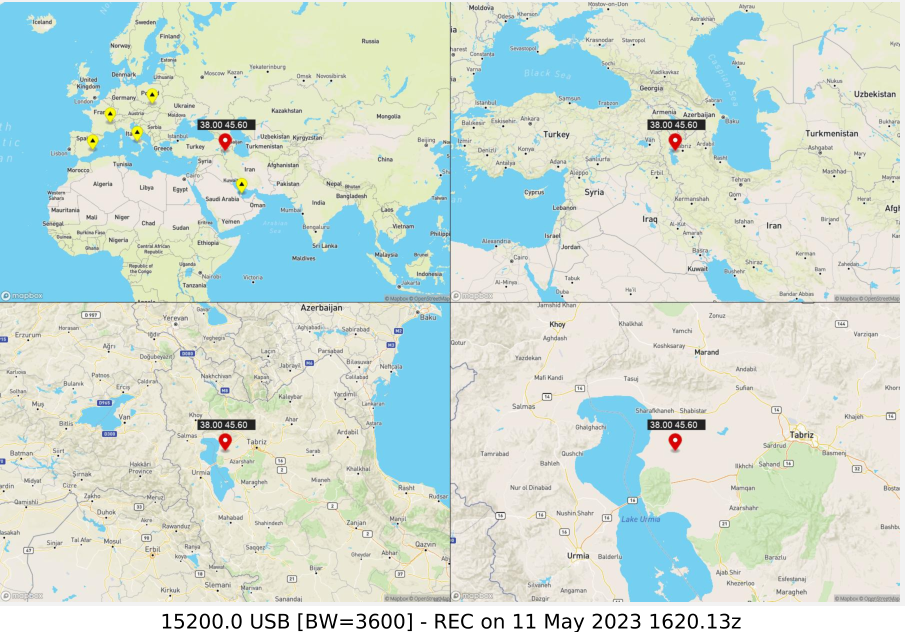
As for locating the Tx site, my friend Philby attempted a TDoA search which resulted in a site near Lake Urmia (Fig. 4): the lake is located between the provinces of East Azerbaijan and West Azerbaijan in Iran, and west of the southern portion of the Caspian Sea. It's interesting to notice that near this location you may find a combined Mil/Civ airfield hosting  a IRIAF (Islamic Republic of Iran Air Force) composite unit helicopter/transporter aircraft as support of the border regiment of Urmia.
 
Fig. 4
 Comments are always welcome.