20 October 2015
19 October 2015
THALES: Système 3000 robust MFSK-8 and TRC-177x family serial modem
tags:
Systeme3000,
THALES
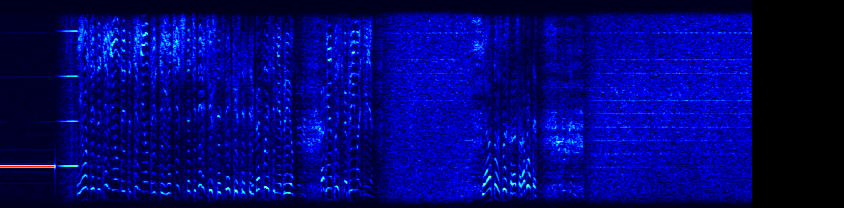
just heard this morning on 16256.5 USB at 0857z, probably source French Military.
The MFSK-8 waveform uses the same tone library as 188-141A/B 2G ALE but callsigns are limited to a maximum length of 2 figures only and can also be used as a robust-data mode. Aurally and visually it is easily mistaken for a normal ALE since the 250 Hz spaced eight tones and 125Bd speed.
The serial-tone waveform more probably belongs to THALES TRC-1752 modem, has all the characteristics inherent STANAG-4285 (serial tone carrier 1800 Hz, speed 2400 baud and modulation PSK-8) except for the phase constellation of the preamble: a 'special' with 5-ary constellation maybe for receivers tuning purposes. ACF is 106.6 ms.TRC-1752 modem seems to be replaced by the HF Multi Mode modem TRC 177X family.
![]() |
| the two combined THALES waveforms |
![]() |
| serial tone ACF |
18 October 2015
Unid 2400bd (mixed) PSK bursts
I started to follow these burst from ~0800z on USB 16257.0 (16259.0 cf) on 17 October, they appeared pretty regularly in seconds 10, 25 and 40 (mm.10, mm.25, mm.40) for more than one hour then they stopped, or at least I did not hear them anymore.
The signal have 18 tones preamble followed by a sort of mixed PSK-4/PSK-8 modulation at 2400 symbols/sec, carrier is measured at ~1900Hz (but I could be mistuned). The SA phase-plane module vaguely reveals a PSK-8 constellation when its n-ary detector is set to 8, but that same constellation comes out also in case of 4-ary. ACF/CCF is 20ms lenght and is visible in the phase detector after the preamble.
It looks like the Chinese DQPSK, but I am not positive about this identification; the recording is available on simply request: comments are welcome!
![]() |
| Pic. 1 - the unid burst |
![]() |
| Pic.2 - 4-ary and 8-ary constellations |
![]() |
| Pic. 3 - phase detector output, note the 20ms pattern |
![]() |
| Pic. 4 - CCF and signal frame |
15 October 2015
how fading or AGC may confuse the things...
tags:
SA
looking inside a 3 KHz serial tone, I was puzzled by its 2 x PSK-8 rings unusual constellation: baudrate (3000 symbols/sec) and ACF (640 msec) made me think to the CIS-3000 waveform... but that PSK shape was not the expected one, so I asked my friends Karapuz and Angazu to hear their opinion and they gave me an hint: "hey, look at the amplitude of the signal!".
That's right: highlighting a single chunk of signal and selecting the SA wave form-module, is visible an amplitude variation, possibly due to fading, that in turn causes a sort of inter-symbol distortion in the phase plane and then the optical effetct of the two concentric PSK-8 rings. My wrong because, just in case, before I had to ran the wave-form module. Same conclusions if I had increased the printing delay in the phase plane as an instant-replay.
Well, good to know... especially if tinkering with AGC.
![]() |
| the two PSK-8 rings... |
![]() |
| ...and its clarification |
14 October 2015
CIS-60: just carriers
carriers only, w/out modulation, in this CIS-60 sample recordered at 14202.0 KHz on USB a fews days ago (added here beacuse of the signal strength). In that same listening-session, after the tone at ~850 Hz I listened to a short speech (in Russian language), a radio-check requested by the operator behind that CIS-60 (chizh-64) and directed the other side of the peer (neon-37): "neon 37 here chizh 64, how do you read me. Work, work" followed by data sending in CIS-60 data mode (translation from Russian by my good friend KarapuZ).
All recording files are available.
Subscribe to:
Posts (Atom)