Showing posts with label Tadiran/Elbit. Show all posts

12 May 2023

TADIRAN HF modem running in scrambler mode (2)

Fig. 1

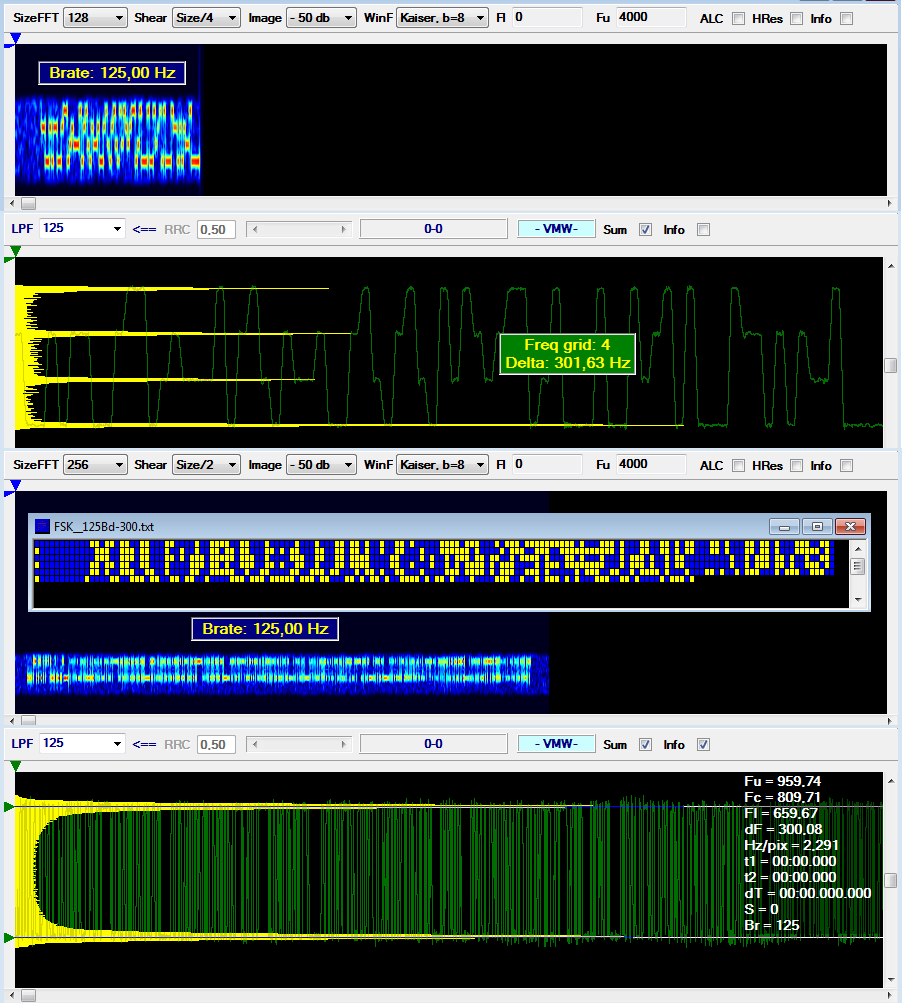
Tadiran/ElbitHF modem, probably the HF-6000 model, running in COMSEC mode using FSK 125Bd/300Hz Digital Coded Squelch (DCS) and scrambled voice-comms. The FSK segmentes (the DCS part) sent during the scrambled voice-comms have a speed of 125Bd and 300Hz shift, ie same parameters of the initial F7B (apparently MFSK-4) waveform, and cosists of a 160-bit period bitstream (Figure 2).

Fig. 2 - main DCS parameters

 It's worth note that the transmission was sent using LSB (Figure 3).

Fig. 3

https://disk.yandex.com/d/novPamUmQksXmg

4 February 2020

Israeli Navy running their proprietary PSK serial tone with Tadiran/Elbit DCS (Digital-Coded Squelch)


Reading radioscanner.ru I found an interesting post my friend Cryptomaster about Israeli Defense Force (IDF) Navy transmissions consisting of their proprietary PSK serial tone waveform sent along with the Tadiran/Elbit Digital Coded Squelch (DCS) signal activated. Since the Istraeli Ny transmissions are quite frequent and easy to receive and recognize, I decided to take a look at the frequency reported by Cryptomaster (13372.0 Khz/USB): the transmissions were picked up using the Italian KiwiSDR owned by IZ6BYY.

The DCS signal is sent continuously, starting when transmission begins, and transmitted on a frequency which is slightly higher than the one used by the data signal (i.e. "over" the data signal) by using an FSK waveform wich is modulated at the rate of 125 bit/sec and 290 Hz shifted (Fig. 1).

Fig. 1
Tadiran/Elbit DCS implementation is a 84 bit long string, while standard DCS [1] codewords consist of 23 bit long string (10 bit data + 3 fixed bits + 11 check bits): don't know if a similar framing is used here. Anyway, notice that at the end of each transmission the encoder changes the code to a pattern consisting of the same string sent in opposite polarity: most likely it's a "turn off" code that causes receiving decoders to mute (Fig. 2) and to signal the end of the data transmission.

Fig. 2 - Tadiran/Elbit DCS bitstream
Radios with DCS options are generally compatible, provided the radio's encoder-decoder will use the same code as radios in the existing network. indeed, the use of DCS has only been noted on this frequency: Fig. 3 shows contemporary transmissions on 13372 and 8070 KHz/USB. Notice that the two signals occupy the same bandwidth: it may be that before DCS were applied the PSK signal is subjected to a tighter filtering.

Fig. 3 - Isr-Ny contemporary transmissions
DCS support could be provided by Tadiran/Elbit devices such as the HF-6000 or HF-8000 [2]: I already met that signal coupled with the Nokia msg terminal.
Since a compatible radio ignores signals that do not include a bitstream with the specified code, DCS could also be used as a type of selective calling. Indeed, the Tadiran "Selective Calling" feature (that's not ALE) just uses an FSK waveform as DCS: perhaps the DCS words "open" the squelch of the addressed radios (all, group, individual) but it's only a my guess...

Fig. 4


5 June 2018

Nokia msg terminal + Tadiran HF equipment

Transmission picked up some days ago by my friend AngazU using the SM2BYC Kiwi sdr. The signal is composed of an initial tone followed by a preamble consisting of F7B modulation (apparently MFSK-4) and two simultaneous FSK modulations (Fig. 1). As suggest by cryptomaster and KarapuZ, this is an interesting example of a Nokia Adaptive MSG Terminal which is used along with a Tadiran HF equipment that presumably provides an active noise cancellation feature (Tadiran DCS, Digital-Coded Squelch).

Fig. 1 - waveforms
The upper FSK 125Bd/290 delivers the same 84-bit pattern and it's interesting to note that the last 84-bit sequence is sent in opposite polarity:  perhaps signalling the last group/block of data (sent in the lower FSK).  The same parameters (FSK and 84-bit pattern length) has been discussed here in radioscanner:
Although, of course, we can be wrong because a specific description of this function was not found TADIRAN HF modems.

The lower FSK 300Bd/780, after the initial 1-0 sync sequence pattern, delivers data and seems to have a 16-bit period. After differential demodulation the stream exhibits 8 solid bits columns in a 16-bit period and once removed the stream does not have a clearly defined period (Fig. 2).

Fig. 2 - bitstreams
Cryptomaster is inclined to the Machester modulation but I get errors in both the phase conventions (G.E.Thomas and IEEE 802), and he pointed me that the signal has a constant preamble whicH is not coded using Manchester (Fig. 3) and causes mistakes in decoding.

Fig. 3

As for as I can see, the same F7B + FSK125Bd structure is sent first but without the lower FSK300Bd (Fig. 4). The patterns are the same in the two FSK125Bd streams, perhaps it is used to initialize the (supposed) Tadiran noise blanker function?

Fig.4

14 October 2017

TADIRAN HF modem running in scrambler mode

Tadiran/ElbitHF modem, probably the HF-6000 model, running in COMSEC mode using FSK 125Bd/300Hz Digital Coded Squelch (DCS) and scrambled voice-comms. Transmission heard on 5885.0 KHz/USB at 0755z with a very poor SNR. The sample marked as "A" is the "autocall" waveform: it precedes the MFSK/scrambler sessions, marked as "B", and terminates the link (Figure 1).
Fig. 1
The FSK segmentes (the DCS part) sent during the scrambled voice-comms have a speed of 125Bd and 300Hz shift, ie same parameters of the F7B (apparently MFSK-4) waveform, and cosists of 84 bit repeated strings:

Fig. 2

Fig. 3

12 October 2016

TADIRAN AutoCall MFSK-4


signal heard on 5892.0 KHz/USB, 0758 UTC, most likely from Austrian Military. AutoCall is a proprietary ALE waveform by Israeli Tadiran/Elbit communication system. AutoCall delivers faster and more reliable link establishment and is recommended when greater tactical efficiency is critical; AutoCall is used eg in TADIRAN HF-6000 radio system. HF-6000 system is also sold by Telefunken Racoms.
model VRC-6020 (20 W)
Some characteristic elements of the signal can be observed from the sonogram:
  • the 1000-Hz tuning/sync beep which preceeds all transmissions;
  • the proprietary MFSK-4 Autocall system's tones centered at 2850 Hz, serving a variety of linking and communication functions;
  • the four tones located at 2400, 2700, 3000 and 3300 Hz

Manipulation speed is 125 symbols/sec and the step between two tones is 300Hz.