Showing posts with label French-Ny. Show all posts

16 November 2021

4339.8 KHz, an occasional French-Ny fleet broadcast FSK channel ?

On Sunday evening I came across an FSK 50Bd/850 transmission on 4339.8 KHz (CF): first time I have ever seen a S-4481 on this frequency, usually occupied by French Navy fleet broadcast in STANAG-4285 from FUG Saissac on 4338.0 KHz (// 4325.0 Khz). The dozens of DF tests carried out have all indicated the same FUG site as the location of the transmitter, while the analysis of the bitstream revealed the use of KW-46 encryption which is normally used in NATO 50Bd/850 FSK fleet-broadcast.
Actually I expected to find the classic 21-bit pattern, typical of domestic broadcast, even if 4339.8 is not among the FSK channels used by the French navy (see here).  I thought about a new FSK channel, but in subsequent monitoring the frequency has always resulted to be occupied by STANAG-4285 transmissions.
It's interesting to note that the same frequency/mode appears only once in the UDXF logs, precisely on March 21  of this year and only nighttime: coincidentally this too during the night between Sunday and Monday.  

Fig. 1 - STANAG-4285 & 50Bd/850 FSK both KW-46 secured from FUG

Fig. 2 - 4339.0 KHz FSK Direction Findings (TDoA algorithm)


https://disk.yandex.com/d/laasTSzeM0o7fQ

11 February 2021

weird, but intriguing, 75bps Baudot encoding with 3.8 stop bits (prob. ACP-127 msg)

That's a very interesting Baudot 75Bd/850 FSK signal recorded (and sent me) by my friend cryptomaster on 6721 KHz/USB: although its nominal parameters lead to an async STANAG-4481 transmission, the analysis (Figure 1) reveals an unexpected stop-bit length of 3.8 bits(!), i.e. an unusual 5N3.8 framing (it's to notice that, in case of lost sync, the stop-bit stretching allows faster resync and framing of the incoming data).

Fig. 1

Since the bit editor works using integer numbers (it can't draw half bit), the bitstream is shown with the 5N4 framing  (Figure 2, negative polarity): it means that parsing the 5-bit code will inevitably produce some errors.

Fig. 2 - the bitstream as it appears after demodulation

At first glance, the decoded text looks like a message with errors due to a noisy signal or having a poor SRN (Figure 3), but an in-depth analysis of one of the decoded text reveals interesting details that allow us to identify sender/recipient and the very nature of the message: in my opinion, a radar detection report sent in ACP-127 style message. Obviously, decoding suffers from the non standard framing so, after various decoding runs, I re-built the message using the parts taken here and there and that -in my opinion - make more sense.

Fig. 3 - Baudot decoded text

T-O  081506z Fet 21
that's the DATE-TIME-GROUP (DTG)  of the message; indeed, as you can see in Figure 1, the transmission was recorded on 2021-02-08t15_12_04z so we have 08 (day 8) 0815z (time) february 2021 (Fet 21). This way of coding the date also corresponds to what is indicated in the Code FM-13-x-SHIP (or shortly FM-13) [1].

FM TIRPA 29 TO CEFAE
FM
is the originator's sign, the originator of this message is indicated by the designation immediately following. TIRPA  is the callsign adopted by the French Aviation Defense Service (ICAO DEF), TIRPA 29 could be an aircraft  [2]. TO is the "Action Addressee", ie the addressee(s) immediately following (CEFAE) is to take action on the message.

INFO AERO LANN BIHOUE
INFO is the Information addressee sign (as "CC"), in this message is the French Naval Aeronautical Base of Lann-Bihoué located in the Atlantic region, placed under the operational command of the Atlantic zone (AERONAV/AWLANT, see below) [3].

MCA ACT/AERONAV/AWLANT
likely the Aéronautique Navale (AERONAV) operational command of the Atlantic zone (Air Wing Atlantic, AWLANT). Since the "scene", MCA could mean Maritime Cryptologic Architecture (here the term "cryptology" refers to the SIGINT functions of the maritime Services and incorporates Information Security or INFOSEC functions).

NMR/004 NP 0802 TXT LR 3/1
number of the message (NMR 04), date February 8th (NP 0802) and format of the message (TXT)

DDGH/FRA/JEWNDE VIENNE
the term "VIENNE" could be misleading (city of Wien) but actually JEWNDE VIENNE stands for "JEANNE DE VIENNE", a F70 type anti-submarine frigate of the French Navy. DDGH is the acronym of Destroyer, Helo Capable, Guided Missile.

GPOSIHION 4642.7N/0023.9W SUFFIX GOWF PAPA
it's likely a (geo) position  (suffix is probably GP, GOLF PAPA ). Don't know the format the coordinates are expressed, it seems they do not exactly follow the FM-13 [1] specs even if the terms North and West are easily recognizable. Trying a parsing, the result is quite realistic (46°25'12", 2°23'24")

ROUTE/VITESSE 293 VRAA
respectively course and speed (see below)

And here things get more interesting:

RMQ:CFTERCEPTION ESM DRBV 26A X SN 40270 / CONFIANCE 3
DRBV 15 / SN 65+53 / CONFIANCE 3
 

I guess this text refers to INTERCEPTION ESM, where ESM stands for Electronic Support Measures: i.e. something related to radars [4], indeed:

- DRBV-26A (Jupiter) is a Thomson-CSF early warning radar performing long-range air surveillance on board medium and heavy-tonnage ships. DRBV-26A operates in D-Band, and is available with a cost-effective fully solid-state transmitter [5][6]
- DRBV 15 (Sea Tiger) is operating in S-Band air and surface surveillance and target designation radar. The system is designed for medium to large ships and can be integrated with weapons systems [7] [8]
- CONFIANCE is the degree of the detection confidence, levels range is from 1 (low) to 3 (high).

 SN 40270 and SN 65+53 are probably some of the out measurements from the radars.

BT /0 NNNN
Break and End-of-Message Indicator (EOM)

Since the French Navy frigate "Jean de Vienne" is equipped with both the radars (DRBV-26A and DRBV 15) [9], I think that the recorded transmission could be an ACP-127 tactical message about a radar detection (or something very similar to it). It's not clear to me who the fields position-course/speed refer to (sender? ship? or maybe the radar target?).
Anyway, it's quite unusual to see such (prob.) ACP-127 messages in clear text as well as the 5N3.8 framing, probably derived from a STANAG-4481F modem: could they be trainings? Comments are welcome.

 
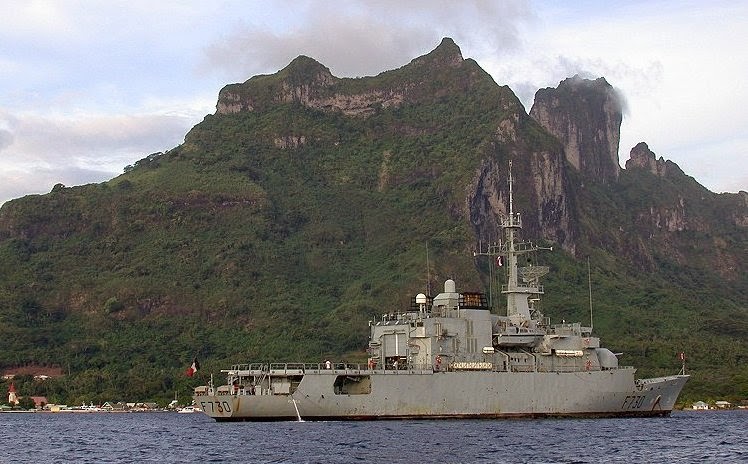
Frigate Jean De Vienne (CC BY-SA 3.0, https://commons.wikimedia.org/)

Update (thanks to Jean-Marc Liotier @liotier)
CEFAE Centre d'entraînement et de formation de l'aéronautique navale, navy school in Lann-Bihoué.
Looks like training is the reason for using this elderly format to report ESM sightings.


23 May 2018

French Navy Broadcast, FSK 50Bd/850

Following the previous post, I decided to analyze the French FSK 50Bd/850 in order to replicate the results obtained by my friend Christoph Mayer in his blog: happy to say that the results coincide.


French-Ny FSK 50Bd/850 has a characteristic 21-bit period and, in a way similar to STANAG-5065, two/three sub-frames which are delimited by the bits of two LFSR markers M1 M2 and a logical "1" value bit (1-bit). The sequences for the two markers are generated by the LFSRs described by the polynomials x^6+x^5+1 and x^7+x^6+1.
Since the missing of an initial sync in the recording, the 1-bit can occur in any position within the 21-bit frame therefore markers' positions are reported as relative to the 1-bit. A possible more significative layout shows 2 possible sub-frames (5 and 13 bits length).


Obviously, the length of the markers' patterns match the length of the respective generator polynomials.


One of such transmissions  heard on 8516.8/usb (offset + 2000Hz) has DF'ed to "La Regine" (Saissac), callsign of the station is FUG

26 February 2018

French Navy FUE, STANAG-4285 asynchronous ITA2 framing

updated
Looking at milcomm logs in the web, I noted that the STANAG-4285 clear-text test transmissions of the French Navy call "FUE" from Brest are logged with different indications of the ITA2 data-format (here called as "framing"): sometimes 5N1 and sometimes 5N2, as also reported in some youtube video clips [1].
I tuned their 6348.0 KHz/USB frequency and recorded a sample of these transmissions, then I processed the wav file using two S-4285 well known decoders: sorcerer and multiPSK. It is interesting to note that the two programs correctly decode the test messages using both 5N1 and 5N2 framing settings (Figs. 1,2) and this is certainly curious because seven and eight bits are not the same thing.

Fig. 1
 
Fig. 2

Looking at the bit outputs produced by the two decoders, the stream is structured in five bits of data (ITA2 coding, commonly referred to as Baudot) sandwiched between one start bit and two stop bits, ie a 5N2 framing (Fig. 03).

Fig. 3 - sorcerer/multiPSK bitstream output
If the recorded transmission (S-4285 from FUE) were a "pure" 5N1 then things would be different since decoding with the 5N2 setting would produce errors, as in the case of a 5N1 CARB transmission from the Italian Navy IDR (Fig. 4).
 
Fig. 4 - decoding of a pure 5N1 transmission from Italian Navy "IDR"
Then, I tried to process the wav file from FUE using the HARRIS RF-5710A modem, configured for S-4285 600bps/L, connected to Realterm, a serial terminal program [2] (not a decoder!): the DTE port of the modem was in synchronous mode. These tests show that Realterm detects framing errors when the 5N2 setting is used, whilst the reception  is correct when the 5N1 setting is used (Fig. 5): indeed a different result if compared to that seen with sorcerer and multiPSK where the 5N2 setting produces right decodings (Fig. 6).

Fig. 5 - 5710A -> Realterm
Fig. 6 - decoding of the streams from Realterm
So it seems that not 5N1 neither 5N2 are used. By the way, Figure 7 shows some possible ITA2 framing derived from ASCII-bits output of sorcerer.

Fig. 7

That said, it's seems that we face a non-standard framing: 1 start bit, 5 ITA2 data bits, and <1-2> stop bits... or perhaps there is something odd in these decoders. I try a possible explanation.
Sorcerer and MultiPSK, two software modems/decoders, even if they do not provide the exact framing, they are able to recognize this data format by synchronizing their framing window to the incoming stream, say a "dynamic window", so that we get correct decodings using 5N1 or 5N2 settings. Realterm, just an RS-232 terminal, works with "static" framing windows of the UART, which are suited to the standard formats. So, facing this stream it most likely can synchronize using the 5N1 format because in case of 5N2 the UART does not see an integer number of stop bits.
About the graphic representatiosn of the bits in Fig. 7, it is worth saying that the bit editors work with an integer number of bits (they can't represent half bit) and that anyway the bit stream is the result as parsed by the decoder(!) and not the raw stream before the parsing. The 5N1.5 bit view is possible by aggregating two consecutive frames and then get an integer number of 15 consecutive bits (ie 7.5 x 2): as shown in Figure 7, the 15-bit period stream just exhibits 2 start bits and 3 stop bits... as expected for two aggregate 5N1.5 frames. Quoting Utility Planet "ITA2 bit states are based on timing, and they do not correspond to the base-2 places used in binary numerical notation" [3].

I noted the same behavior in a recorded transmission from Fort de France Martinique FUF (downloaded somewhere from the web): in this case I used multiPSK (Fig. 8).

Fig.8

As a final note, the ending message "INT ZBZ" (interrogative ZBZ) in military terms stands as "What is the printing acceptability of my signals ?", or simply "everything is ok with my transmission?" [4].


[1]  https://www.youtube.com/watch?v=8YBJ05aJcnA   


23 June 2017

the beauty of grayline

188-141A calls copied this morning around 0455 UTC on 11111.0 KHz/USB (Fig. 1). The ALE addresses  belongs to the French Navy naval bases at overseas departments and territories Papeete and Noumea:
1OMFUM French Navy OMAR Net, Papeete OCE
1OMFUJ French Navy OMAR Net, Noumea NC
more than 16000 Km far from my antenna: reception has been possible thanks to a grayline-path (Fig. 2).

Fig. 1 - decoding
Fig. 2 - the grayline at the reception time

It's interesting to note that, at that same time, exploiting the same grayline path I also had a good copy of CHU Ottawa Canada (Fig. 3).

Fig. 3

Grayline observations and predictions can be read at the VOACAP (Voice of America Coverage Analysis Program) site:
http://www.voacap.com/p2p/index.html
as well as a lot of interesting and accurate services about about HF propagation:
http://www.voacap.com/ 

French Navy OMAR (Organisation MARitime des transmissions haute fréquence) HF New-Generation program have the task to modernize all the High-Frequency transmissions media of about 80 assets of the Ocean forces of the French Navy, maintaining interoperability with other NATO Navy. The project was committed to Thomson-CSF (now THALES):

9 July 2015

French Navy OMAR HF-NG

09/07/15 14716.6 1OMFUJ French Navy OMAR net Noumea, NCL 0555z USB MIL 188-141A clg 1OMFUM then into THALES TRC-1752 modem Stanag-4285
 

OMAR (Organisation MARitime des transmissions haute fréquence) HF New-Generation program had the task to modernize all the High-Frequency transmissions media of about 80 assets of the Ocean forces of the French Navy, maintaining interoperability with other NATO Navy. The project was committed to Thomson-CSF (now THALES):

The ALE calls logged here show the common prefix 1OM (One Organisation Maritime) followed by the usual French Navy IDs:
FUJ = Noumea, New Caledonia
FUM = Papeete, French Polinesia

I do not know if the "1" in the prefix stands for HQ or something other: there are logs that report such ALE calls just w/out any number (OMFUF) as well as calls with a different number (2OMFUM).


About the waveforms, the ALE one is a plain MIL 188-141A while the PSK segments have all the characteristics inherent STANAG-4285 (serial tone carrier 1800 Hz, speed 2400 baud and modulation PSK-8) but they are not recognized by such decoders. 

The lack of PSK strength does not allow an accurate analysis, but given the presence of Thomson-CSF/THALES in the OMAR project, it is very likely that it could be the TRC-1752 modem PSK-8 waveform, as reported here: http://signals.radioscanner.ru/base/signal101/
(I already heard this wavefrom on March http://i56578-swl.blogspot.it/search/label/THALES%20TRC-1752).

Looking for TRC-1752 modem, it seems to be replaced by the new 17xx HF multi-mode modem family:
https://www.thalesgroup.com/en/worldwide/defence/naval-forces/c4isr/communications/hf-multi-mode-modem 

15 August 2014

French Navy on HF (USB/Stanag-4285)

(always-under-revision post)
 
The French Navy, officially the Marine nationale ("National Navy") and casually called La Royale, is the maritime arm of the French military. Tracing its roots back from 1624 it is one of the world's oldest naval forces and historically played a key part in establishing the French colonial empire.
The motto of the navy is Honneur, patrie, valeur, discipline ("Honour, Motherland, Valour, Discipline") and these words are found on the deck of every ship in the fleet. Since 2008, its roles have been defined as maintaining intelligence, protecting populations, preventing crises, intervening wherever necessary to reestablish peace, and dissuading any threats against vital French interests. The French Navy does not use prefixes of the names of its ships (such as the Royal Navy uses HMS, for instance). Foreign commentators sometimes use the prefixes "FS" (for "French Ship") or FNS (for "French Navy Ship"); these are not official, however.


The French Navy is 44,000 men and women (37,000 military and 7,000 civilians) serving France, with more than 180 ships, 200 aircraft and 6 commandos units. Assuring a permanence presence of: 30 ships at sea, 5 aircraft in the air, an SSBN undersea. All those units are shared between 6 specific forces. As a blue-water navy the Marine nationale operates a wide range of fighting vessels, including a nuclear-powered aircraft carrier, nuclear-powered submarines, frigates, patrol boats and support ships. 
Major naval bases in use are; Toulon, Brest, Ile Longue and Cherbourg in Metropolitan France. Fort de France, Degrad des Cannes, Port des Galets, Nouméa and Papeete at Overseas departments and territories. As well as bases in foreign countries such as Abu Dhabi, Dakar and Djibouti.
La Régine hosts a Very Low Frequency (VLF) Naval communications facility. Using 28 transmitters and antennas (the highest one over 300m) the facility provides contact with the French nuclear ballistic missile submarines at sea.
It's official callsign is FUG.

STANAG-4285 well known callsigns
FUE Brest
FUV Djbouti
FUF/OMFUF Martinique
FUG La Regine/Saissac
6WW Dakar
FUM Papeete/Thaiti
FUX Reunion 
FUJ Noumea
FUO Toulon

Below, some screenshots about my receptions of the French Navy stations operating on HF USB/STANAG-4285:

FUV - Djbouti

FUF - Fort de France, Martinica

FUM - Papeete, French Polynesia
 
6WW - Dakar, Senegal


FUE - Brest, France
FUG8 - La regine, France

FUG12 - La Regine, France
 
All information in this document was submitted by independent radio monitors or has been obtained from public available sources and public sites on the web. Wherever data was obtained via the web or elsewhere, references and/or links to these sources have been noted.
 
French Navy HF fleet broadcast is discussed here: