Showing posts with label Rus-Experimental. Show all posts

16 December 2025

A new Russian PSK8 serial waveform

Some days ago my friend cryptomaster sent me an interesting recording dated December 4, 2025 about a test of new communications equipment conducted in the Russian Federation. The signal was recorded at the frequency of 15014.0 KHz/USB kHz and its external modulation parameters are similar to NATO standards used for serial waveforms, namely the symbol rate is 2400 Baud and the transmission mode is PSK8 (Figure 1). 

Fig. 1 - serial waevorms main parameters

The analysis of the ACF is very interesting (Figure 2). I think that the real structure of the frame is 106.66 ms which - at the speed of 2400 Bd - corresponds to a frame length of 256 tribit symbols (or 768 bits): a length quite usual in such PSK8 waveforms. In my opinion the strong 1173.33 ms spikes (corresponding to 2816 tribit symbols) could be caused by the interleaver (or the scrambler) length: in this case 8448 bits. As you know, an interleaver (and a scrambler) is deterministic and periodic and because of that, it can introduce hidden periodic structures into the signal, even if the original data looks random. When you compute the ACF, those periodicities may show up as spikes at specific lags. In this case 8448 is not a "casual" number but it's a quite structured one corresponding to 1056 bytes and it is exactly a multiple of the length of a single frame, ie 768 × 11 = 8448 (as you can see in Figure 2). 

Fig. 2 - ACF analysis

Something similar happens in MS-110A at low data rates (<1200 bps): in those cases, one group of four frames count 160 symbols (4×40) and it's just "in sync" with the scrambler length (160 symbols) causing the strong 66.67 ms ACF spikes rather tha the expected 16.67 ms [1].
About the interleaver, in the Russian MIL context the interleaver lengths are usually specified explicitly in bits or symbols (quantitatively), not categorized as “short,” “medium,” or “long” (qualitatively) like NATO documentation sometimes does, so if I'm right it could be a 8448-bit block interleaver, 1.17 s depth.

Now, why I talk about a Russian waveform? The analyzed signal is actually a segment of a longer recording which also includes some op-chats which are clearly in Russian language (Figure 3).

Fig. 3 - spectrum of the entire recording

My friend cryptomaster kindly provided me with a transcript of the chat. I didn't translate it, as the possible use of military jargon would have distorted the translation. The full transcript is available as a "transcript note" at the bottom of the post. Anyway, the .wav file you can download contains the entire recording (op-chat + signal).

The analysis of a 8448-bit slice of the PSK8 demodulated bitstream (only a conversion of phase positions), reshaped to a 768-bit period, doesn't help to detect/identify some sort of structured framing. Although repeating blocks of data are easily identifiable, the "usual" structure of Known/UnKnown data as we are used to seeing in similar waveforms is missing (Figure 4). Given the "experimental" nature of the transmission, it's possible that the same structures are being sent... but this is just pure speculation.
A more in-depth study of the code is certainly necessary, as is the need for further catches of this waveform.

Comments are welcome.

Fig. 4 - 768-bit period

 https://disk.yandex.com/d/oRognr-CGqxbgg

[1] https://i56578-swl.blogspot.com/2021/06/188-110a-acf-lengths-and-interleaved.html

transcript note
- 121, парусу.
- Парус, я 121, вы принимали от меня телекод? Квитанцию отдал, но вы не приняли по всему. После этого свой телекод отправил, но не принял от вас квитанцию.
- Мы отправку делали, получили на неё квитанцию и ваше сообщение получили и тоже дали квитанцию. Приём.
- Принято, отправьте в нашу сторону ещё одно сообщение.
- отправляем.

(передача сообщения)

- 121 парусу.
- у меня нет приёма. Приёмник не работает.
- (непонятно) или нет приёма, всё-таки?
- "Бозон" работает, а "чинара", у меня приёмник не работает на неё.  Дайте счёт до двадцати, я послушаю на приёмнике.
- Ну, канал, может быть, немного ушёл, но эти "ноги" снять сегодня не успеем, как поняли? Прём.
- Хорошо, да, ладно.
- Даю счёт (передаёт счёт до 20), приём.
- Парус, я принимал от вас на четыре бала, наверное, но с прерываниями.
- Может, на другой канал перейдём? Повыше? Приём.
- Давайте, перейдём на другой канал. 

13 November 2023

a new family of wideband OFDM waveforms

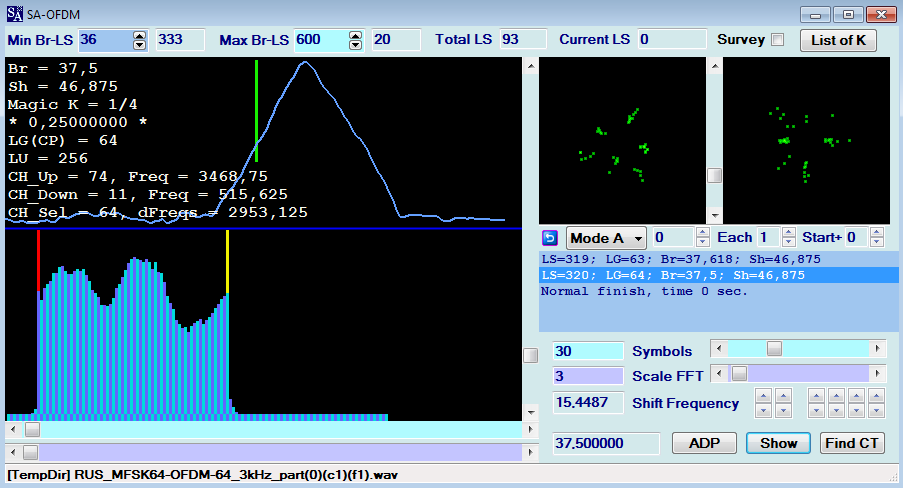
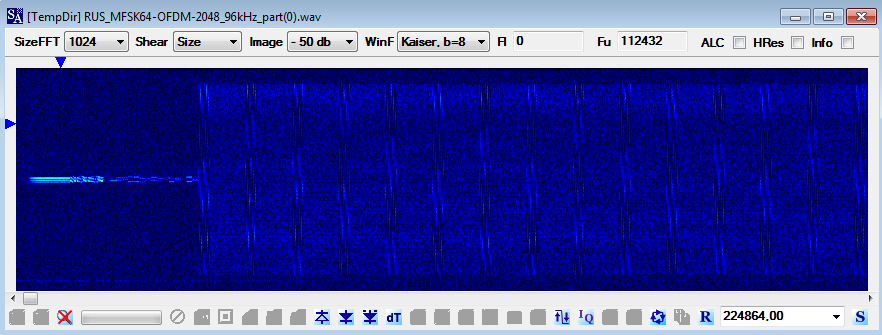
A new family of wideband OFDM signals has recently appeared on-air, most likely tests of Russian origin, and which - at least according to the observations carried out so far - seems to be composed of six waveforms which for convenience I call OWF (OFDM Waveform):

OWF3: 3 KHz bandwidth, OFDM 64-tone
OWF6: 6 KHz bandwidth, OFDM 128-tone  *
OWF12: 12 KHz bandwidth, OFDM 256-tone
OWF24: 24 KHz bandwidth, OFDM 512-tone  
OWF48: 48 KHz bandwidth, OFDM 1024-tone    
OWF96: 96 KHz bandwidth, OFDM 2048-tone

 * the OWF6 waveform has not been observed "directly" but its characteristics and main parameters can be obtained from early-test transmissions [1]

Note that, unlike the western 188-110D App.D (single-tone waveforms, not OFDM), the bandwidths of 9, 15, 18, 21, 30, 36, 42 are missing.
The six waveforms share some common features:

1. initial preamble consists of an LFM segment followed by MFSK-64 37.5 Bd segment
2. MFSK segent is followed by up-chirped FMCW (Frequency Modulation Continuous Wave) sweeps
3. data transfer is arranged in 15 OFDM blocks, separated by chirps as in 2
4. OFDM blocks have all the same speed of 37.5 Baud and same channel separation of 46.8 Hz
5. in some waveforms (OWF1, OWF24, OWF48) the initial MFSK preamble is followed by the same up-chirped sweeps as in 2

It's interesing to note that OFDM parameters fit DRM-B ones.

OWF3 (3 KHz bandwidth)

Fig. 1 - 3 KHz bandwidth waveform

Fig. 2 - 3 KHz bandwidth OFDM

OWF6 (6 KHz bandwidth)

Fig. 3 - 6 KHz bandwidth waveform 

Fig. 4 - 6 KHz bandwidth OFDM


OWF12 (12 KHz bandwidth)

Fig. 5 - 12 KHz bandwidth waveform 

Fig. 6 - 12 KHz bandwidth OFDM


OWF24 (24 KHz bandwidth)

Fig. 7 - 24 KHz bandwidth waveform
 
Fig. 8 - 24 KHz bandwidth OFDM

OWF48 (48 KHz bandwidth)

Fig. 9 - 48 KHz bandwidth waveform 

Fig. 10 - 48 KHz bandwidth OFDM

OWF96 (96 KHz bandwidth)

Fig. 11 - 96 KHz bandwidth waveform

Fig. 12 - 96 KHz bandwidth OFDM

While the vast majority of Western countries use single tone waveforms (see the aforementioned MS-110D) Russian friends favor the development of multi-tone waveforms, as OFDM in this case: I am not able to make a comparison of performances, there is certainly a valid reason behind preferring one approach or the other.

Thanks to my friends ANgazu, Joni, Linkz and KarapuZ for sending me their recordings.

(to be continued)

https://disk.yandex.com/d/s4FclhpM7ZFbAw

[1] http://i56578-swl.blogspot.com/2016/05/cis-ofdm-64-tone-qam-16-40bd.html

23 February 2023

unid "mixed-mode" transmission

 updated

 Very interesting "mixed-mode" transmission cathced and sent me by by friend Michel (F1GOC)

Fig. 1

Segment 1 consists of an FSK modulation keyed at 200 Baud and 1000 Hz shift (Figure 2). The demodulated bitstream has a well defined period of 288 bit consisting of a data segment preceded/followed by a sync/probe sequence (Figure 3).

Fig. 2
 

Fig. 3

Segment 2 consists of an MFSK-7 modulation keyed at 30 Baud and 400 Hz separation between the tones. The raw demodulation of the seven tones (0-6;000-110) shows a repeated sequence of 940 bit length (Figures 4,5).

Fig. 4

Fig. 5

Segment 3 is the most interesting one. This segment consists of 7 subcarriers which coincide with the tones of the previous MFSK segment (see Figure 1), the modulation used for each subcarrier - in my opinion - seems to be ASK2/OOK. The "aggregate" speed of modulation is 200 Baud, ie 28.5 Baud per channel (Figure 6). The autocorrelation function of the signal shows a period of 10 seconds, corresponding to 2000 bit frames (Figure 7).

Fig. 6

Fig. 7

As a simple curiosity, the central frequency of the FSK segment does not coincide with the value of the center band of the following two segments (see Figure 1). Difficult to state the user and the purpose of the transmission, many "experimental" signals are in the air especially during this period, comments are welcome.

------- update  --------------------------------------------------------

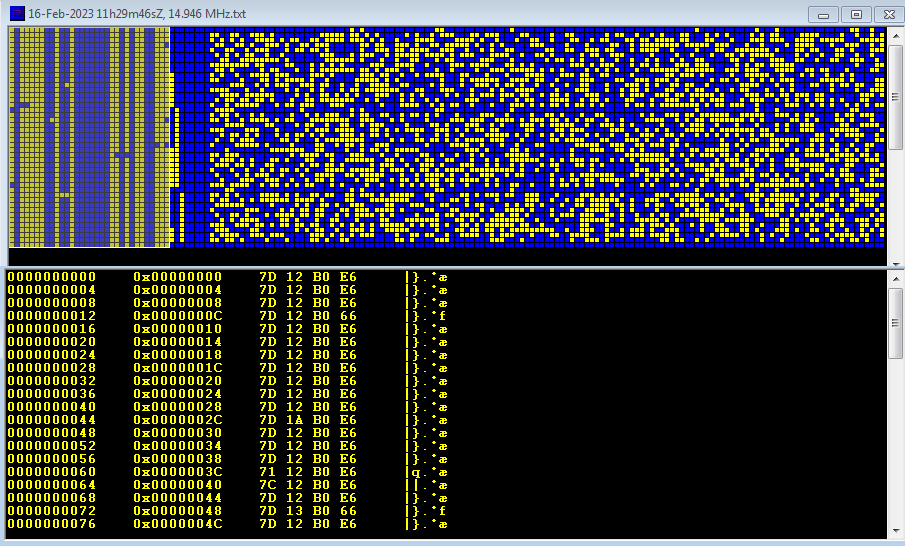
As my friend cryptomaster commented (and my friend Nicola too in pvt), the FSK segment is the well-known Russian Intel "F06" waveform. Indeed, after the change of the bit-order is possible to clearly see the typical F06 32-bit sync sequence 7D12B0E6 (Figure 8). The final part of the decoding, thanks to the rivet_b90 tool, is shown below (Figure 9). 

And... yes, I'm a bit out of shape since the 288-bit period should have suggested the solution 😁

Fig .8 - F06 sync sequence
 

Fig. 9 - F06 decoding

https://disk.yandex.com/d/2hsIqrswtSwzHw

16 December 2020

Unid MFSK-13 system

Unid MFSK-13 system running at different speeds (31/62.5/125 Baud) and intervals (125/250 Hz) spotted on Twente WebSDR on ~10625, ~9091, ~7779 KHz/USB thanks to friend radiotehnikaT101. 

Fig. 1
Fig. 2

It's to be noticed the quick change of the waveform in the 10625 KHz recording (from 31Bd/250 to 125Bd/126): maybe the first part could be the "call" segment. I tried a rough demodulation by replacing the Hex characters (0...C) with their binary value (0000...1100) but I didn't find anything interesting in the bitstreams except some patterns in the 31Bd/250 segment (88/176 bit period).
Most likely  these are experimental transmissions in the network of the Ministry of Foreign Affairs of the Russian Federation. 

Fig. 3

https://yadi.sk/d/ShwOzo4-qA6Ygg
https://yadi.sk/d/oAWEbU54GvHljQ 

13 November 2020

OFDM 17-tone PSK4 62.5 Bd, "struna" HF (струна)

Heard on 10994.0/USB (10995.5 CF) starting from 1020Z on Twente WebSDR. That "Struna" HF waveform consists of OFDM 17-tone modulation using PSK4 at 62.5 Bd, tones are 62.5 Hz spaced. Struna transmissions take place on a pool of frequencies at .10, .20 and. 30 minutes every hour. Thanks to cryptomaster for the tip and radiotehnikaT101 for warning about the on-air signal presence.


https://yadi.sk/d/byshR4UAz-BAAQ


12 November 2018

a mix of waveforms and modes (FSK, MFSK, OFDM)

Just another example of a mix of waveforms and modes (FSK, MFSK, OFDM) supposedly used by Russian Intel and spotted on 9122.0 KHz/USB.


https://yadi.sk/d/EOtOSyeKrfI8gQ

11 September 2017

MFSK 21/13 tones 31.5/63 Bd (125 and 250 Hz spaced)


unid MFSK modem spotted on 12138.8 KHz/USB, according to the suppressed carrier during MFSK, and switching from 21-tones 31.5Bd (125Hz shift) to 13-tones 63Bd (250Hz shift).  Note also the espansion of the spectrum since the occupied bandwidth varies from 2600Hz (MFSK-21) to 3000 Hz (MFSK-13).

Fig. 1
Fig. 2
Apart from the two edge tones, the MFSK-13 uses the same ten odd tones of the MFSK-21 waveform:

Fig. 3
Transmissions may have different duration, maybe depending on the length of the messages to be sent: from few seconds up to 6 minutes (the longest I copied). Sometimes the transmissions use only the MFSK-21 waveform and two adiacent channels for the peers (maybe ISB?):

Fig. 4

The MFSK-21/13 signal was also copied on 9280.0 KHz (frequency of the carrier) and reported in radioscanner here. They ascribe the transmissions to not well identified "domestic" (Russian?) telecomm operators.


8 June 2016

CIS MFSK-16 175Hz (updated)

This 16-tones signal occupy a bandwidth of about 2700 Hz, from 385Hz of the lower tone to 3010Hz of the top tone (dF = 2625Hz), with 175Hz increment steps as shonw in pics. 1,2:

pic. 1 - spectrum of the MFSK-16 signal
pic. 2 - the 16 tones grid
Since last January, this modem has been observed on several frequencies on USB and running at multiple speeds but all with the same constant frequency shift of 175Hz.  
An interesting feature of this signal is its speed of manipulation, I spotted 4 different waveforms with speed that increases about at a '2x' rate, i.e.: 16.4, 33, 66.6 and 132.4 symbols/sec (pics 3,4,5,6)

pic. 3 - 16,4 Bd
pic. 4 - 33 Bd
pic. 5 - 66.6 Bd
pic. 6 - 132.4 Bd
Formerly the MFSK-16 phase was preceded by an MSK preamble with ~1866Bd and ~928Hz shift (pic. 7)
pic. 7 - MSK preamble before MFSK-16 transfer
Although the preamble may appear as a QPSK modulation, a more carefull analysis indicates the MSK mode (pic. 8)

pic. 8 - preamble speed and mode

21 March 2016

CIS 5 x MFSK-16 + BPSK 250Bd (2)

Just to point out some interesting analogies with a similar MFSK-16 signal, heard in the latest days of the past September 2015.
That signal had the same MFSK parameters, 5 x 16 tones 10Bd 20Hz, but with FSK inserts each 10 seconds rather than the BPSK inserts seen in these days . SOM and EOM shows the same style. While the BPSK version has a fixed lenght of 21:05 minutes, the FSK version had a 33 seconds lenght and was repeated each 15 minutes.
One could say that the BPSK version seen in these days is a sort of evolution of the semptember FSK (test ?) version, but it's probably a speculation.

18 March 2016

CIS 5 x MFSK-16 + BPSK 250Bd


this interesting signal (supposed to be used by "Russian Intelligence") has been heard on 13497.0 KHz and 15812.0 KHz USB on 30 October (from 1300z to 1330z) and on 15845.0 KHz USB on 18 March (from 1300z to 1320z).
The most interesting feature are the BPSK inserts, each 10 seconds, that modulate in turn 6 different 250 Hz spaced carriers at 250 symbols/sec. Apparently there isn't a certain order of choice of the six carriers or a sort of cycle so it's difficult to say something about the scope of these inserts. Since they do not carry informations, they could be sent for tuning filters and equalizing MFSK demodulator purposes, but it's only my guess.


About the MFSK part, it's possible to individuate five distinct MFSK-16 channels with tone separation of 20Hz and 10Bd speed


Most likely the signal is a sort of FTD waveform. All the heard transmissions end with the same ~860 ms sequence  2 frequencies, modulated in some frequency time shifted method.