Showing posts with label KNL. Show all posts

20 October 2017

BPSK 4800,9600,19200Bd 6,12,24 KHz (Marine Band)

Other WideBand burst waveforms spotted in HF Marine band: speed 4800, 9600 and 19200 Baud, bandwidth  6, 12 and 24 KHz.

Fig. 1 - 16625.0 KHz/USB
Fig. 2 - 16657.0 KHz/USB
Still uncertain whether these transmissions concern the over-the-air tests of KNL Networks CNHF (Cognitive Networked HF) system, as they illustrated in their presentation slide of this system (Fig. 3), or perhaps a real-world testbed/implementation.

https://yadi.sk/i/7bcD0sWZHqF6sw
 Some info about CNHF system can be read in their website.


14 October 2017

BPSK & QPSK 2400Bd, QPSK 1500Bd, ARQ system (Maritime Band)


Robust ISB SDR ARQ system heard on 6231.5 KHz/USB (Maritime Mobile band) 2800Hz offset from carrier, around 0630z on 12 October and in which the two channels are used as follows:

- on USB upper channel: user data transfer using adaptive 2400 Baud PSK-2 and QPSK burst waveform, according to the channel conditions and the feasible data-rate. Initial bursts use PSK-2 modulation at 2400 Baud;  
- on LSB lower channel: link and traffic management (ACKs and mode used for data transfer) using 1500 Baud PSK-2/QPSK waveform; 

is not clear if the change of the mode used for data transfer is signaled in the management channel by the caller or it is requested by the called station.

Fig. 1 - user data transfer waveform (upper channel)
Fig. 2 - link and traffic management waveform (lower channel)

At least in this sample, data bursts last 2088 msec for PSK-2 and 3144 msec for QPSK, the initial bursts have a duration of 520msec; link and traffic management bursts last 310 msec. PSK-2 and QPSK data bursts exhibit strong ACF spikes every 523 msec which suggest a 1256 symbols frame structure (Fig. 3); initial data bursts have ACF = 0, probably Walsh modulation is used (Fig. 4).

Fig. 3
Fig. 4
Together with IK1YDE we studied the bitstreams after PSK-2 and QPSK demodulations and found a frame structure similar to those provided by the recent MS-110 Appendix C for the waveforms ID 5 and 6 (Fig.5). Indeed both PSK-2 and QPsK frames consist of 288 symbols (Fig. 6): 32 knwon symbols (mini probes) followed by 256 unknown (data user) symbols. It must be noted anyway that the data rate of the analyzed waveform (in its USB channel) is 2400 Baud and doesn't match the one provided by the waveforms 5 and 6 of MS-110 App.C.
Most likely the 1256-bit ACF is due to the length of the interleaver or the scrambler sequences.

Fig. 5
Fig. 6 - data bits and symbol numbers

A similar system was heard on 5 November 2016: in that case ACK burst were sent after each BPSK data burst (Figs. 7,8)
.
fig.7
fig.8

Talking with KarapuZ about this system, he suggested a SDR equipment rather than a ISB mode (I edited the text of the post accordingly) and proposed to have a look at the KNL Networks website since they are testing a proprietary 3G HF hybrid system (termed CNHF) to support the ship traffic in Artic regions [1]. In that high latitudes satcomm links can't be easily used since geostationary satellites do not cover these areas, moreover due to the long dark periods the low portion of HF shall be used (lack of F layers). Perhaps may catches are related to their tests... but it's only my guess (I emailed them to ask a confirm and maybe shed some ligth on this system).


7 September 2017

BPSK 4800Bd 6KHz (Maritime Band)


Bursts copied on USB 16975.0 and 17157.0 KHz, in the 16-17 MHz Marine band segment. The waveform uses BPSK modulation at 4800 Baud and a bandwidth of 6 Khz, the copied bursts have a duration of ~386 and ~505 msecs.
Speed and bandwidth lead to think to MIL 188-110C App.C "WBHF" but this standard povides BPSK/4800Bd waveform only for 9 KHz bandwidth.

Fig. 1

Fig. 2


6 November 2016

BPSK 2400Bd 3Khz, QPSK 4800Bd 6 KHz (Maritime Band)


These are unidentified signals heard by me and my friend KarapuZ in the Maritime Band segments, mainly 8 and 12 MHz, during daylight. Transmissions are a mix of 3 KHz and 6 KHz wide channels and use PSK modulation, symbols rate is dependent on the bandwidth:
3 KHz BW: 2400 symbols/sec, BPSK modulation (fig. 1)
6 KHz BW: 4800 symbols/sec, BPSK and QPSK modulation (figs. 2, 3)

fig. 1
fig. 2
fig. 3

3 March 2016

QPSK 1500Bd-19200Bd (Maritime Band)

Thanks to my friend KarapuZ, I recently had the opportunity to play with some signals heard in HF maritime segments, fixed and mobile services, mainly recordered on 8400 and 12300 KHz/USB.
The most of these signals have wide-band high-speed performances (although they do not belong to 188-110C App. D) as the following 19200Bd DQPSK whauch occupies a band of  ~24KHz bandwidth (pic. 1).

pic. 1
As in almost all these signals, a 1500Bd starting block seems used to announce or precede the session. As shown in pic. 2, this block has 1500Bd BPSK modulation in the preamble and trailer segments and 1500Bd QPSK modulation in the data block; the follwing three segments have 19200Bd QPSK modulation (pic. 3).

pic. 2 - 1500Bd starting segment
pic. 3 - 19200Bd segments
By selecting and analyzing the second 19200Bd segment, the longer one, we can get some clues about its frame structure. Looking at pic. 4 we can see frames of alternating data and miniprobe symbols. Each data frame consists of a data block followed by a BPSK mini-probe consisting of symbols of known data.  After 4 data blocks, the initial BPSK preamble (or an its symbol subset) is reinserted most likely to facilitate late acquisition of an ongoing transmission.
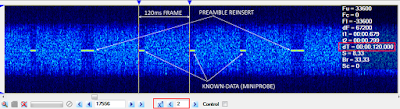
pic. 4 - frame structure
Frame structure and times are confirmed by running both CCF and ACF functions (pic. 5): note that 120ms frame makes 2304 QPSK symbols, ie 4608 bits, at 19200 Baud speed.
 
pic. 5 - CCF and ACF results
In order to find the data block and known data (miniprobe) lengths we need to investigate the 120ms frame by using a bitstream analyzer as shown in pic. 6.
 
pic. 6 - 19200Bd segments
As expected, the period legth is 4608 bits that matches the 120ms or 2304 QPSK symbols. Since the mini-probes consist of well known data, their pattern is easily recognizable into the bitstream and we can get a pretty acurate measurement of the length: 512 bits, ie 256 QPSK symbols (pic. 7)

pic. 7 - known data lenght
Unless my mistakes, each 2304 symbols frame consists of a data block consisting of 2048 data symbols followed by a mini-probe consisting of 256 symbols of known data. After 8192 data symbols, ie each four data blocks, a 584 known symbols set (preamble?) is reinserted (pic. 8) [1]

pic. 8 - frame structure

Little or nothing can be said about the secondary protocol: we can work on just the over-the-air symbols, unless to find the scrambler ploynomial, interelaver lenght and CRC algorithm... but that's another story.

My friend Alipio pointed me to an interesting question: the superframe length and the way to measure it.
We know that the superframe consists of 9544 symbols:

4 data-blocks: 8192 symbols
3 mini-probes: 768 symbols
reinserted-preamble: 584

while Alipio says that the reinserted-preamble is made up by the fourth miniprobe + the preamble itself (as in MS188-110 style):
4 data blocks: 8192 symbols
4 miniprobes: 1024 symbols
1 preamble: 328 symbols

Perhaps it's only a question of interpretation of the fourth mini-probe.
  

[1] MIL-STD 188-110C W/ CHANGE NOTICE-1 (03-JAN-2012) removed the Paragraph D.5.4 sentence "The reinserted preamble facilitates acquisition (or re-acquisition) of an ongoing broadcast transmission." since it refers to a feature that is obsolete.