Showing posts with label T-600. Show all posts

28 July 2026

CIS-Navy FSK 50Bd/700 Flash Messages

This post presents a technical analysis of an HF radio intercept recorded on July 22. The analysis focuses on the structure of a 50 Baud FSK signal transmitted by the CIS Navy, highlighting both standard transmission characteristics and distinctive operational features, such as the use of a specific frequency shift (700 Hz) and the inclusion of a Morse-FSK preamble indicative of high-priority message traffic.

A very interesting FSK 50 Bd / 700 Hz signal was intercepted on 16199.75 kHz (cf) on July 22. The signal transmits almost continuous "01" reversals, occasionally interrupted by a Morse-FSK preamble prior to an encrypted payload. The preamble likely serves as a signaling sequence indicating the priority/precedence level of the upcoming transmission. As shown in Figure 1, the payload of the recorded transmission consists of two concatenated messages framed by short reversal segments before returning to continuous reversals. In ordinary or low-priority traffic, the payload directly follows the reversals (without a preamble), consists of multiple concatenated messages and can last for some minutes.

Fig. 1: the intercepted signal

As confirmed by fellow monitor cryptomaster, the intercepted signal belongs to the family of 50 Bd FSK waveforms used by the CIS Navy with various shift values such as 75, 200, 250, 500, and even 1000 Hz [1] likely generated by the T-600 system, while maintaining the same message format. This is the first time I have observed a CIS Navy 50 Bd FSK modulation with a 700 Hz shift, which is another remarkable aspect of this sample.

Fig. 2: FSK parameters

Transmitting a Morse coded preamble typically indicates an incoming message of high priority. In Russian military radio doctrine, top-priority traffic (equivalent to FLASH or MONOLITH) is preceded by repeated letter sequences to alert operators and trigger automated equipment (1). In this instance, the preamble consists of the string 'UUUUU XXX XXX'. This sequence likely functions as a two-stage marker: 'UUUUU' for initial synchronization/attention, followed by 'XXX XXX' to signal an incoming long or high-precedence message prior to switching to FSK data modulation. Notably, while these markers are unconfirmed by official Russian Navy sources, they are well-established through decades of independent SIGINT monitoring. A similar preamble was previously documented in CIS Navy 50 Bd/75 transmissions on 18.1 kHz (submarine communications) [2].

Fig. 3: the Morse-FSK preamble

The two messages in this sample are identical, likely to improve system reliability through message redundancy.
Below is the bitstream analysis of the intercepted sample (700 Hz shift), demonstrating the above—namely, that both the message's format and the symbol rate of 50 Bd are shared across CIS Navy FSK waveforms, even when using different shift values.

The 'standard' format of CIS Navy 50 Bd FSK messages usually consists of:

 ⦁ 42-bit initial sequence / Unique Word (usually 100001010010111110000101001101011010101101)
 ⦁ 70-bit Initialization Vector, repeated twice)
 ⦁ 7-bit word ciphered payload arranged in a 4:3 ratio with parity check
 ⦁ five 7-bit "0001000" words as End of Message (EOM)

(the 0/1 values of the sequences above depend on the reception polarity)

(not in scale)

42-bit sync sequence
It is worth noting that the transition from idle to traffic condition is signaled by a break in the bit reversal structure, where a '1' is inserted instead of a '0' when the system transitions to traffic i.e., ending in '01011' rather than '01010', as shown in Figure 4. Using intentional protocol deviations for signaling is a common practice across many standards, such as Ethernet LAN protocols (2).
The initial 42-bit sync sequence also represents a "violation" of the 4:3 ratio (see below), ensuring reliable synchronization.

Fig. 4: 42-bit initial sequence sent after reversals

70-bit Initialization Vector
Figure 5 displays the identical pair of messages aligned in 70-bit blocks, emphasizing the probable Initialization Vector (IV) sequences, repeated twice, prior to the encrypted payload.

Fig. 5: 70-bit sequence, repeated twice

4:3 ratio with parity check
The payload data consists of 5-bit characters encoded into a 7-bit sequence with a fixed 4:3 ratio of '1's to '0's (or vice versa, depending on reception polarity). Naturally, the constant presence of four '1's per character also provides parity-based error detection. 

Fig. 6: 4:3 ratio and parity check
End of Message (EOM)
The End-of-Message (EOM) sequence in Figure 7 consists of five identical 7-bit words "0001000", again violating the constant bit ratio of the payload section. This figure also clearly demonstrates that the two messages are identical. 

Fig. 7: the EOM sequence

It appears that the format of the CIS-Navy 50Bd transmissions revolves around the number "7": an initial 42-bit synchronization sequence (6x7), 70-bit Initialization Vectors (10x7), and a payload structured into 7-bit words. In fact, it can be argued that the entire message (sync sequence, IVs, payload, EOM)  is fundamentally structured into 7-bit words.

Attempts to geolocate the transmitter site proved challenging, likely due to the nature of the signal and potential multi-hop propagation. Nonetheless, as shown in Figure 8, the KiwiSDR receivers used for Time Difference of Arrival (TDoA) measurements point to an area southwest of Moscow (likely the RDL site?), though this cannot be established with a high degree of certainty (3).

Fig. 8: direction finding attempts (TDoA)

All recordings thanks to linkz's KiwiSDR [3].

Downloads
📄⬇️ For a quick technical reference, you can download a concise Fact Sheet summarizing the full frame architecture and other features here.
📡⬇️ Download signal recording: https://disk.yandex.com/d/4uBK5oJYGYtMVg

Notes
1. In NATO military communications (as ACP-126 standard), FLASH precedence is represented by the letter indicator Z (Prosign). To alert operators and trigger automated terminal alarms, the precedence sequence is repeated at the start of the transmission (e.g., ZCZC ZZZZ), followed by a Z time-stamp designator and the text header FLASH FLASH FLASH. In strategic/command contexts, it functions similarly to Russian high-priority or MONOLITH-type alerts.
2. In traditional 10 Mbps Ethernet networks (10BASE-T), data is transmitted using Manchester encoding. Transmission begins with a 7-byte preamble consisting of alternating 1s and 0s (10101010...), used to synchronize the receiver's clock. Immediately following this is the SFD (Start Frame Delimiter) value, where the alternating sequence breaks with two consecutive 1 bits (10101011). This break in the alternating rhythm signals the network chip: "Attention: the preamble has ended; the very next bit marks the actual start of the Ethernet packet" (IEEE 802.3 Standard, Clause 3).
3. Rather than a single fixed mast, HF transmissions under the call sign RDL are routed through naval communications hubs primarily tied to naval headquarters/command nodes in Central Russia such as the Moscow military region hub. Just for example, Naro-Fominsk area hosts major command posts and communications infrastructure for the Russian Armed Forces, including high-power HF transmitter facilities and receiver centers used for strategic naval command broadcasts and central military district communications.

References
[1] http://i56578-swl.blogspot.com/2016/12/unid-fsk-50bd1000-prob-cis-navy.html
[2] http://i56578-swl.blogspot.com/2020/08/cis-navy-vlf-50bd75-fsk-t600-75hz.html
[3] http://linkz.ddns.net:8075/?f=16198.00usbz9

6 November 2021

a note about CIS Navy FSK (T-600)

My friend Nicola, whom I thank for the collaboration, reported to me an inaccuracy in the post of April 16, 2021 "CIS Navy FSK 50Bd/250 (T-600)", more precisely regarding the 44-bit sequence which is sent after the reversals:

11100001010010111110000101001101011010101101  

The 44-bit sync sequence is in fact a 42-bit sequence (six 7-bit characters). The reason is that the transition from idle to traffic condition is signalled by a violation of the bit reversal structure so that a '1' is inserted instead of a '0' when the systems transits to traffic condition, ie the end is '...0101011' and not '01010' as given in my post (figure 1). That initial sync sequence of six 7-bit characters is also a violation of the 4:3 ratio. This ensures that sync is reliable. To use violation as signalling is quite common in many protocols, e.g. Ethernet LAN protocols.

Fig. 1

Generally speaking, one should notice that 'primitive' block protocols as the ones used by the Russian Navy will have this general structure:
- Call and acknowledgement provided by morse coded session
- Bit sync provided by bit reversals with or without a final violation
- Character sync provided by an initial Unique Word (or sync sequence, the designation is a matter of semantics)
- Possibly, but not necessarily a header (address, length, type of message etc.)
- Data, including possible initialization vectors or session keys
- End-of-Message
- End-of-Transmission, which could be provided by yet another morse session

16 April 2021

CIS Navy FSK 50Bd/250 (T-600)

50Bd/250 FSK is another waveform used by CIS Navy for their fleet broadcast. Unlike the same waveform but with 136-bit framing (T-600 136), this one shows all the characteristics of the (perhaps more) well known 50Bd /200 broadcast, ie:

* 44 initial 42 bit initial sequence (usually  "100001010010111110000101001101011010101101")
* 70-bit Initialization Vector (ten 7-bit words, repeated twice)
* payload arranged in the 4:3 ratio
* 7-bit words "000100" as EOM


https://disk.yandex.com/d/zr9Mj7M7jII2xQ

28 August 2020

CIS Navy VLF 50Bd/75 FSK (T-600 75Hz)

50Bd/75 FSK is the T600 waveform variant utilized by Russian Navy on 18.1 kHz, commonly for submarine communications.

Fig. 1 - 50Bd/75 waveform
 
As seen in CIS 36-50, frames are constructed from data blocks consisting of 7-bit words with a fixed ratio of '1's vs. '0's of 4 to 3 or vice versa, depending on polarity of reception (Figure 2). 

Fig. 2 - 4/3 ratio test on a five-message transmission (s1 and s2 data blocks are the same)
 
Multiple Russian military naval communication stations share this frequency (18.10 KHz) and the call sign "RDL".  The 24h transmission schedule has frequent flash-override messages in A1A Morse, FSK-Morse and T600 75 Hz, as shown in the lower image of Figure 1.

https://yadi.sk/d/0M7f_H_WOD9LTA (T600-75 bitstream)

23 June 2020

CIS Navy 50Bd/500 FSK 136 bit (T-600-136)

Yet another 50Bd/500 FSK transmission, this time recorded monday morning on 14704.0 KHz (cf) around 1340Z and almost surely sourced by the CIS Navy T600 system (typical shifts: 200, 250, and 500 Hz): given the 136-bit length frames this waveform is also known as "T600-136".

Fig. 1 - FSK parameters
Note that the full transmission period is 544-bit length, i.e. 4 x 136-bit frames. Indeed, from a quick examination of the demodulated bitstream (Fig. 2), it is easy to see that it's composed of blocks of four repeated frames, probably to add redundancy to the system.

Fig. 2 - CIS-Ny 50Bd/500 bitstream (136-bit frames)
 
The same 136-bit framing is also used in the CIS-Ny 50Bd/250 FSK, still from a T600 system (Fig. 3): these two waveforms seem to be used to carry the same "type" of messages unlike the CIS-Ny 50Bd/200 FSK which shows a different structure of the frames (70-bit Message Indicator, 4:3 ratio,...) and it's mainly used for fleet broadcast.

Fig. 3 - CIS-Ny 50Bd/250 bitstream (136-bit frames)

Although the shift is a multiple of the manipulation speed, the two tones do not preserve their phase (Fig. 4).

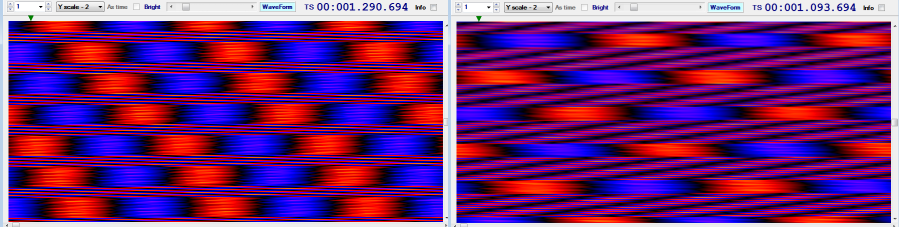
Fig. 4 - CIS-Ny 50Bd/500 tones

23 April 2017

CIS FSK 50Bd/250 136 bit (T-600-136)


Interesting signal from my friend KarapuZ: it's the quite uncommon 50Bd/250 136 Bit by some Cis networks, most likely CIS Navy. The waveform is similar to the well known T600 (50Bd 200/250Hz) but in this case the full period is 544 bits lenght, ie 4 x 136 bit frames.

Fig. 1
Fig. 2

13 December 2016

unid FSK 50Bd/1000 (prob. CIS Navy occasional test)


Strong - and odd - signal copied on 12376.0 (cf) at 1423 UTC on 11 December. This is probably a totally occasional test since the used fequency and some other points as below. The signal exhibits a well defined 100Hz keying at transitions edge (Figure 1):

Fig. 1 - 10Hz FM: a) after phase detector, b) SA scan-raster method
although the raster shows 50 symbols/sec as the value of the modulation speed: maybe the 100Hz keying si due to a filtering failure. After filtering the signal to 50Bd value, it's possible to get a 1000Hz value for the frequency shift (Fig. 2).

Fig. 2

Some notes about the demodulated stream, thanks to  radioscanner friends Karapuz and Cryptomaster for their advices and comments.
It's worth noting the presence of 2 x 70 bit repeated sequences in the preamble (likely the Message Indicator), as in Fig. 3, which resembles the  CIS Navy T-600 modem (ACF = 70 bit in the preamble only) although the constant 50Bd speed and the shift of 1000 Hz is quite rare for such modem (typical shifts are: 200, 250 and 500 Hz). Also note as the End Of Transmission "000100" sequence contains at least 4 EOT characters and the 4:3 ratio alphabet code (Fig. 4). 

Fig.3
Fig.4


13 October 2016

CIS Navy 50Bd/200 FSK (T-600, BEE-36, CIS 36-50)

Sinchronous FSK 36-50Bd/200 system also known as CIS 36-50 and used by CIS Navy for their fleet broadcast. Transmissions start with an initial revs sequence transmitted at 36 Bd followed by traffic in 50 Bd mode. In case of more than one message, the initial 36 Bd reversals are not sent (Fig. 1).

Fig. 1
Frames (Fig. 3) are constructed from data blocks consisting of 7-bit elements: a packet of pay-load data of basically arbitrary length is surrounded by a start and an end sequence (EOM). Sometimes blocks of data already transmitted are observed to be repeated, verifying the contents by the recipient can be performed easily this way. Idle sequences of reversals, i.e. strictly alternating sequences of '0's and '1's, of 36 Bd and 50 Bd are used to introduce and to terminate a transmission or also (50 Bd only) to separate data blocks. A data block itself consists of the three sections start sequence, payload data and EOM sequence; all payload data consist of 5-bit characters coded into 7-bit sequence with a fixed ratio of '0's vs. '1's of 3 to 4 (or vice versa, depending on polarity of reception).  
The start sequence is transmitted after the last '0' bit of the idle sequence and consists of a 44 bit 42 bit sequence (usually  "100001010010111110000101001101011010101101") the ratio of three '0's to four '1's is not followed here to make the start sequence distinguishable from the actual data. The payload data is preceeded by a 70-bit Initialization Vector (ten 7-bit words) which is repeated twice. All subsequent data (arbitrary length) do not obey a special regularity anymore. The end sequence shows five equal 7-bit words "000100", again disregarding the bit ratio of the data section.

Fig. 3
Sometimes T600 is also used to forward flash messages in FSK/Morse mode as in Fig. 4 (transmitted by RDL HQ)

Fig. 4