Showing posts with label Email-over-HF. Show all posts

13 July 2023

PolAF, UUCP over RSX.25 to exchange HF email messages

I have already encountered the Rohde & Schwarz RSX.25 protocol in some transmissions of the German BPOL and Italian GdF, this time (just a few days ago) I spotted such transmissions from the Polish AirForce (Siły Powietrzne - Ministerstwo Obrony Narodowej, MON) on 6884 KHz/USB where they use R&S GM2100 proprietary waveforms as HF bearer and UUCP over RSX.25 to send PostMan II email messages (Figure 1). Transmission were recorded using a Polish KiwiSDR [1].

Fig. 1

Particularly, one of the transmissions being analyzed refers to the nodes with ALE address WARSZAWA2 and BYDGOSZCZ:

TO WARSZAWA2 TIS BYDGOSZCZ
TO BYDGOSZCZ TIS WARSZAWA2
TO WARSZAWA2 TIS BYDGOSZCZ User Unique Function 00 07 (CMD USER UNIQUE WORD)

The used 2G-ALE protocol is the well-known standard 188-141A: the first thing that catches the eye is the use of a User Unique Function (UUF) [2] with the value 00 07 (14-bit ASCII [nul][bel]) in the third frame of the ALE handshake. User Unique Functions enable the transmission of a manufacturer-specific Unique Index which may be used for controlling the subsequent data transmission protocol; in this case, the value 0007 is most likely the particular "index" that R&S uses to signal UUCP/RSX.25 protocol to the receive node.

Data are sent using the HF waveform "Signal Format", a so-called R&S proprietary advanced waveform provided by their GM2100/GM2200 HF modem. The used waveform is the quite common 2400Bd PSK8 occupying a 3 KHz bandwidth (Figure 2). With 8PSK the net data rate of the serial modem is 5400 bit/s, errors are at first corrected by FEC, which reduces net data rate to 2700 bit/s. 

Fig. 2

The framing consists of a 192-symbol sequence preamble followed by one ore more data blocks each consisting of 64-symbols: 48 unknown symbols (coded data) + 16 known symbols ("test sequences"). The postamble terminates the data blocks and consists of a 64-symbol End Of Message sequence. Except for the presence of an initial TLC section(s), the total length is then a multiple of 64 symbols.

Fig. 3

Figure 4 shows the ACF/period of the GM2100 waveform: since the 2400 Baud, the ACF value of 133.33ms corresponds to a 320-symbol period, ie to five 64-symbol data blocks.

Fig. 4

The length of 320 symbols is due to the fact that the 16-symbol test sequences are actually "segments" of a longer 80-symbol sequence and so they are five times repeated, as visible in Figure 4 (unless demodulation errors), hence the length of (48+16)×5=320 symbols, or 960 bit since each PSK8 symbol is mapped to a tri-bit sequence (000...111). 

Fig. 5

After the removal of the HF waveform overhead, the well-known 8-bit patterns of RSX.25 emerge (Figure 6). RSX.25 literally stands for R&S adaptation of wired X.25 protocol to the HF radio channel,ie a modified AX.25 packet radio protocol.
Quoting R&S papers: "RSX.25 organizes the data to be transmitted in packets, which are successively transferred to the data modem. The packets contain a variable number  of  frames, the number per packet depending on radio-link quality and being adapted at regular intervals. The data transmitted in a packet are distributed among the frames. The length of the frame data is variable and also depends on radio-link quality: in channels of very good quality, a frame contains up to 250 data  bytes, in strongly disturbed channels 4 bytes. Errors escaping FEC are eliminated by the ARQ procedure of the RSX.25 protocol." [3]

Fig. 6

The transmitted data are obtained after the removal of RSX.25 encapsulation and packets' reassembly, the file (Hex codes and ASCII text) is edited using the XVI32 hex editor [4] and shown in figure 7. Some known "reserved words" and syntax say that's an email transport performed by the use of UUCP: all messages in the initial handshake begin with a `^P' (a byte with the octal value \020, hex  0x10) and end with a null byte (octal \000, hex 0x00).
 
Fig. 7

UUCP (Unix-to-Unix copy) suite is a set of computer programs and protocols that allow for the remote execution of commands and the transfer of email and files between computers, in this scenario it is used over RSX.25. The human-readable version of  the UUCP "conversation" (just the initial part)  is shown in Figure 8.
 
Fig. 8

The messages can be parsed according to the UUCP protocol internals [5] so to get some other informations about users, SW/HW equipment... and so on.
 
login...Connected...OK 
login section

S Bydgoszcz_HF -pz -vgrade=z -R -N07 ROKN07 Pyie Uy
UUCP handshake 
S  caller hostname = Bydgoszcz_HF
-pz -vgrade=z  requests the called system to only transfer files of the specified grade or higher = z (grades in UUCP links means 'priorities')
-R  caller UUCP understands how to restart failed file transmissions. Supported only by System V Release 4 UUCP, so this is a System V release.
-N07 - caller UUCP understands the Taylor UUCP size negotiation extension (only for UUPlus, so this is UUPlus)
ROKN07 – called station acknowledgement of ‘R’ options. The caller UUCP is acceptable, it specified `-N', and the called UUCP also understands the Taylor UUCP size limiting extensions
Pyie  the called station supports the following UUCP protocols y, i, e
Uy  the calling station selects which protocol to use out of the protocols offered by the called station, in this case the UUCP protocol 'y'
 
pm2mrs -CR D.0097 0666 dso22odn@bydgoszcz.airforce.pl 0x3d26
most likely R&S PostMan II messenger
D.0097 file to send
0666 mode of file, if UUPlus always = 0666 for outgoing files
dso22odn@bydgoszcz.airforce.pl file name
0x3d26 file size (15654 bytes) 

rsmail -v2 -f dso22odn@bydgoszcz.airforce.pl dsocop@warszawa2.airforce.pl
Since PostMan offers  e-mail, fax and file transfer, my guess is that the additional command rsmail (most likely R&S mail)  following the pm2mrs invocation just specifies the email service
dso22odn@bydgoszcz.airforce.pl the caller station (ALE address: BYDGOSZCZ) is the "22 Ośrodek Dowodzenia i Naprowadzania" (22 Command and Guidance Center) [6] located st Bydgoszcz Airport: it's a civilian airport but shared with the Polish Air Force
dsocop@warszawa2.airforce.pl it's the called station (ALE address: WARSZAWA2) , "dso cop" is probably the Armed Forces Operational Command in Warzawa (it's a my guess)
It's interesting to note that in some other recordings the email address are user@warszawa2.airforce.pl and user@bydgoszcz.airforce.pl ("user@" is the common default username as in other message handling systems), although the ALE address remain the same, ie WARSZAWA2 and BYDGOSZCZ.
 
BZh9
Bzip2 4 bytes header, here starts the file to be sent (Bzip compressed)
BZ  Signature (0x425A magic number)
h Bzip2 (h is for Huffman coding)
9  increments of 100 kB block-size uncompressed


It's really obvious that the two stations belong to the Polish Air Force (indeed "airforce.pl" is the email domain name) as well as the use of R&S hardware/software equipment (STANAG/MIL-STD waveforms cannot be used along with the RSX.25 protocol [7]). 
A bit of OSINT demonstrates the R&S support to the Polish Armed Forces:
as well as the use of R&S XK2500L and XK2900L radios (along with Harris RF-5800) at the "Radio Center, Region 4 Air Force ICT Support":
 

Must be noted that PostMan II (now superseeded by PostMan III) is a combined R&S hardware & software product running on a Unix-like communication server: hence the use of such OS, at least in the mail server of the local nets.


Further catches could offer the chance to gather some more intelligence.


18 May 2022

1016-protocol & DatronLINK suite to exchange HF email (R.O.C. Navy)

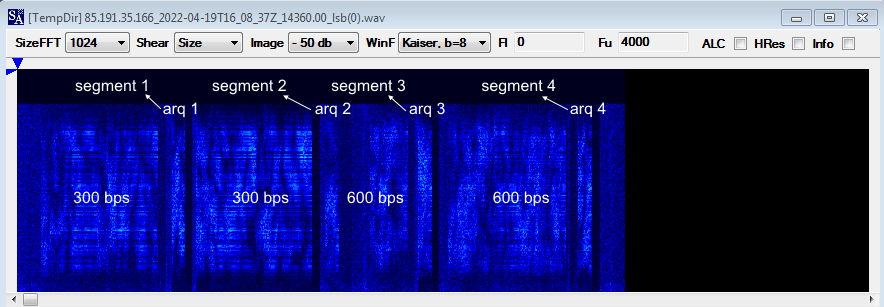
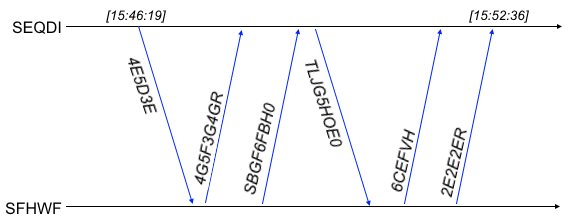
Yet another interesting catch of an email-over-HF session, this time recorded on 14360.0 KHz/LSB at 1608z [1]. The usual procedure is used: logical link setup by 2G-ALE 188-141A 3-way handshake (SADLW caller node, SJJES called node) followed by half-duplex data transmission by means of 188-110A modem (figure 1). The data transfer mode uses ARQ acknowledgements to achieve reliable data transmission; each 188-110 segment lasts 15 seconds, delay of the correspondent ACK acknowledgements is 1500 ms, round-trip time is about 19.8 seconds. 

Fig. 1

During the link setup procedure, special AMD messages are sometimes used to trigger 188-110A data transfer (FAXDATA CK) or chat (AMDCHAT16), as for example:

[16:29:39][TO][SFHWF][CMD AMD][FAXDATA CK][CMD LQA NO RESPONSE MP=(7) SINAD=(31) BER=(5)][TIS][SEQDI]
[18:54:50][TO][SFDAN][CMD AMD][AMDCHAT16][CMD LQA NO RESPONSE MP=(7) SINAD=(31) BER=(15)][TIS][SWHPY]

However, other type of files are sent w/out those preceeding commands. Other than the ordinary ALE calls and soundings, stations quite frequently exchange AMD  strings: maybe it deals with a type of dictionary-based chat but it's only a my guess (figure 2).

Fig. 2

1. protocol analysis 
The terms defined below are used to refer to specific types of data objects in defining the protocol:

datagram: an ordered sequence of data bytes incoming from an user application such as an email client
data segment: an ordered sequence of data bytes that occur consecutively within a datagram
packet: a data segment with datalink protocol incapsulation, also known as Potocol Data Unit (PDU)
tx_frame: a sequence of packets (PDUs) to be delivered to the HF modem
segment: an HF modem transmission (ie, an on-air tx_frame)

The datalink protocol emerging after 188-110A overhead removal has a characteristic packet length of 127 bytes or 1016 bits (figure 3) and probably that is reason because it is reported as a not-well specified "Period-1016" protocol, sometimes also referred to as "Brazil-1016". However, as evidenced by the analysis' results, it's actually a proprietary datalink protocol developed by Datron as part of the company HF email software application named "DatronLINK" (1).
The data stream consists of two different type of packets; notice the 1:2 ratio existing between the number of packets of first two tx_frames and the 4th (the 3rd is a "special" tx_frame) although they have same symbols rate and same duration: the reason is that while the first two tx_frames are modulated at 300 bps the following ones have a double rate modulation (600 bps) and then allow eight packet positions.

Fig. 3

The analysis of the bitstreams allows to do some "reverse engineering" of the datalink protocol so to understand its format and contents. Let's start with the firts two tx_frames (figure 4)

Fig .4

byte 1: This field has always the value 0x01, perhaps it indicates the Type of the packet (data or ARQ)

byte 2: Src/Dst Address field. The different signal strengths and fade patterns in figure 5 indicate that while the segment 1 is sent by the caller, the segment 2 is sent by the called node, therefore the alternation of the field' contents is due to the switch between the destination and source address. Anyway, I do not know if the field is the "source" address or the "destination" one. Since its length, up to 255 nodes can be addressed, and that number is the "limit" of a such a network.

Fig. 5
 
byte 3: don't know the meaning of this field, I can only see that the four rightmost bits indicated as dtg have the value 1,2,3 respectively in segments 1,2,3 & 4 so it could refert to the number of the datagram coming from the upper layer application. Perhaps the four leftmost bits indentify the type of the data segments, but it's just a speculation.

bytes 4,5: the Sequence Number field is a 16-bit field that refers to the position occupied by the data segment whithin the datagram coming from the upper layer application, the value is expressed in ascending order.

byte 6: the Packet Number (or Packet Index) field is the ordinal position of the packet within the tx_frame, is expressed in descending order such that packet number = 0 indicates that the packet occupies the last position in the tx_frame. I think that by numbering the packets in descending order, the receive node will be aware of how many packets the current tx_frame is made up of.

bytes 7-121: Data Segment field. If the data segment has a length less than 115 bytes (because it includes the last data bytes of the datagram), a sequence of null data bytes (of value zero) is appended to the data segment so as to extend its length to 115.

bytes 122-125: 32-bit Cyclic Redundancy Check (CRC)

byte 126: this field has always the value 0x80, as the first field but in reverse order

byte 127: (seecond) Src/Dst Address field. As said above, this field assumes alternate values in segments 1,2 where traffic flows in two directions. Obviously, if one of the two fields is the source address the other is the destination one (and vice versa).

Fig .6

Given that only 2 packets are to be sent (sequence numbers 0,1) the transmitter fills the (otherwise unused) remaining packet positions with repetitions of packets already residing in the current tx_frame, the receive node will inspect the sequence number of each packet received without errors, and use the sequence numbers to identify and discard duplicate packets. 

Fig. 7
 

Given their double data rate (600 bps), segments 3,4 allow 8 packet positions per tx_frame, with the exception of the 3rd tx_frame which consists of only two packets. However it must be noted that the data rate changes (from 300 bps to 600 bps) just in segment 3, thus it's probable that the transmitter uses a "special" 2-packet tx_frame just to test the feasibility of the new mode. This also implies that the datalink application controls the 188-110 modem.

Contrary to what happens in tx_frames 1,2 the contents of the second field (Src/Dst Address) do not change because these tx_frames are sent by the same node (the caller). The "Sequence Number" and "Packet Number" fields do not need further comments, their functionality is even clearer in tx_frames 3,4.

Fig. 8

As above, the transmitter adds duplicate packets to fill all the packet positions allowed by the tx_frame (ie 8 available position in 600 bps segments). 
 
Fig. 9
 
That said, the format and contents of the datalink protocol should be the following:
 
Fig. 10
 

2. ARQ analysis 
Beyond the "local" reception, I think it's interesting to see how that transmission was actually received at the recipient' sites: that can be done by analyzing the ARQ packets (figure 11) used to transfer acknowledgements bewteen the receiving and the sending node.
ARQ packets have a structure of 45 bytes in length which corresponds to 360 bits or 120 PSK-8 tribit symbols, thus each ARQ packet needs a transmission time of 50 msec when modulated at a symbol rate of 2400 Baud (on-air packet duration is 1700 msec).

Fig. 11

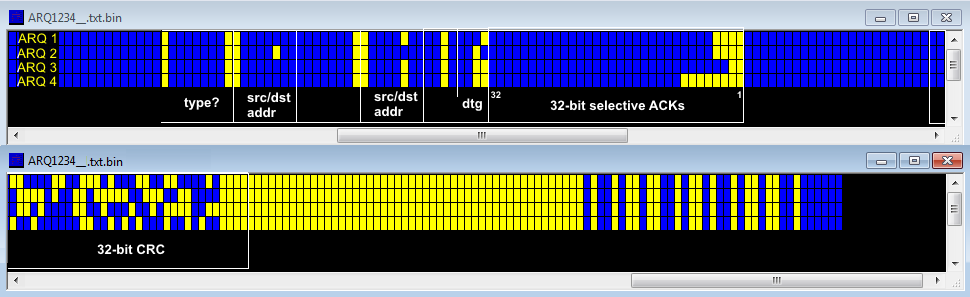
The Format and content of the ARQ packets can be deduced by joining the four demodulated streams and, although I do not know the structure, some fields can still be identified and described:

Type: probably the "protocol field" that identifies this PDU as an ACK PDU

Src/Dst Address: tow fields each consisting of 8-bit address of the sending and receiving node

dtg: indentifies the datagram that is being acknowledged;

Selective Acknowledgements: in the form of an ACK bit-mask that contains one ack bit for each of the packets that can be received in a tx_frame (32 bit = 32 tx_frames sent in a single 188-110 segment at 2400 bps).  Each bit indicates whether the corresponding packet of the "dtg" datagram (ie the corresponding data segment) was received without errors; 1 = ACK (was received successfully); 0 = NAK (not received successfully). Indeed, the number of 1's in the four selective acknowledgements fields match the number of the packets sent in the correspondent four tx_frames (ie: 4,4,2,8).

CRC: 32-bit Cyclic Redundancy Check

Fig. 12

The relationships existing among the fields Src/Dst Address, dtg, and ACK bit-mask are shown in figure below:
 
Fig. 13

3. message analysis
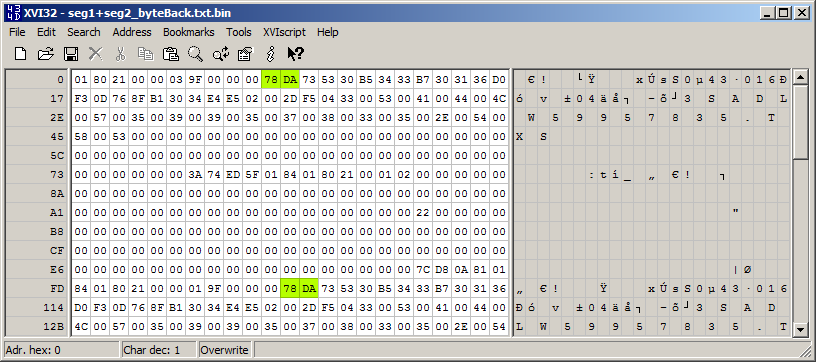
Working on the bitstreams in order to find something that makes sense, I found that data segments must be read in reverse order: that way, ZLIB header 0x78DA (level 9 compression, the best one, as per RFC 1950) and filenames automagically emerge (figure 14).

Fig. 14

The compressed data segments in tx_frames 1,2 consist of the files SADLW59957835.TXS and SJJES122502203.TXS: the filenames contain the ALE callsigns of the nodes involved in the transfer followed by a 8/9 digits number, that number, as well as the extensions ".TXS", is unknown to me. After "inflating" (ie decompressing ZLIB data), the files have the contents F 59678430.MSG\size(?) and C 59678430.MSG\0 

Fig. 15

According with what I saw so far, the first two tx_frames of a data transfer always follow the same paradigm, my guess is that it's a kind of simple negotiation such as "ready to send message_ID" followed by "ready to receive message_ID" so that the receive node is aware about "what" will be sent in the tx_frames that will follow (figure 16).

Fig. 16

The reassembled data segments sent within tx_frames 3,4 - as expected - consist of the ZLIB compressed file 59678430.MSG. Once inflated, headers and body of the message offer interesting insights and information (figure 17). 

Fig. 17

Message-ID header <001001d85407$ffb3b020$0100007f@s0v7n0> reports the host domain/name s0v7n0: this is the host where the being observed message was created

From and To headers "DatronLINK - SADLW" <SADLW@radio.mail> and "DatronLINK - SJJES" <SJJES@radio.mail>  indicates that DatronLINK is the HF email application used: a powerful application developed by Datron and designed to automate message and file transfers over radio links (1), most likely the email domain radio.mail is the default name provided by the application. That domain is clearly not suitable for outbound messaging therefore the gateway function must therefore be provided by the application. 

The References header <1E084D883DFC47E2A5AA8429E352B4D7@RT7000PC1> indicates that the message is a reply to a previous one (or a forwarded one), as also indicated by the presence of the "--- Original Message ---" string. Notice the host domain/name RT7000PC1 that indicates a generic PC1 host which is almost surely wired to a Datron RT-7000 transceiver

The Subject: header =?big5?B?UmU6ILGhuOogwuC1b8SlvtSrSKTl?=  is particularly interesting: according to RFC 2047 MIME the string must be parsed as:  =? <charset> ? <encoding> ? <coded text> ?=
where:
charset = big5,
encoding = B (BASE64),
and coded text = UmU6ILGhuOogwuC1b8SlvtSrSKTl
big5, also indicated in the charset attibute, is a Chinese character encoding method used in Taiwan, Hong Kong, and Macau for traditional Chinese characters (2), BASE64 is a 6-bit encoding (3). Thus I processed the coded text "UmU6ILGhuOogwuC1b8SlvtSrSKTl"  in simple steps using CyberChef tool [3] and google translator (figure 18):

1. convert from Base64 [2]
UmU6ILGhuOogwuC1b8SlvtSrSKTl  → Re: ±¡¸ê ÂàµoÄ¥¾Ô«H¤å
 
2. decode to big5
Re: ±¡¸ê ÂàµoÄ¥¾Ô«H¤å → Re: 情資 轉發艦戰信文
 
3. translate from Chinese to English:
Re: 情資 轉發艦戰信文 → Re: Intelligence forwarding naval warfare letters (as expected!)

Fig. 18

X-Mailer header reveals that users run Windows-based PCs and Microsoft Outlook Express with a build version 6.00.2800.1106 (discontinued, now superseded by Windows Mail)
 
date: and sent: headers Wed, 20 Apr 2022 00:10:33 +0800  and Tuesday, April 19, 2022 11:53 PM say that the message transfer occurred around local midnight, even if sender and receive PC have probably different settings. UTC offset +0800 and character set Big5 are a great help in narrowing down the user detection area
 
subject: header and body of the "Original Message" contain (apparently) incomprehensible ASCII characters which, as specified by the big5 charset, must be encoded in Chinese characters (figure 19):

Fig. 19


As above, the Chinese strings:
 
情資 轉發艦戰信文
收悉請回覆級職姓名及 QSL
FM 532 值機員 電信士官長 李春賢

 
are then translated into English by using  some on-line  tools:

Google:
Intelligence information Forwarding the warship letter
Upon receipt, please reply to the title and QSL
FM 532 Check-in Operator Telecommunications Master Chief Li Chunxian

Yandex:
Intelligence forwarding naval warfare letters
Please reply to the rank name and QSL when you receive it
FM 532 check-in crew Telecommunications Non-commissioned Officer Li Chunxian

Baidu:
intelligence information forwarding ship war letter
Received, please reply the name of the rank and QSL
FM 532 check-in attendant telecommunications Sergeant Li Chunxian

Bing:
Intelligence Forward the ship battle letter
Please reply to the grade name and QSL
FM 532 Check-in Non-Commissioned Officer Li Chunxian

DeepL:
Information Forwarding Letter from Warships
Received, please reply with name and QSL of rank
FM 532 Flight Attendant Telecommunications Chief Petty Officer Lee Chun Yin

The translated texts , although they slightly differ, lead one to think of a "Navy" email traffic (since the term "warship"); FM 532, which appears in the signature of the parent message, could be the Pennant Number of the warship, while Li Chunxian is the name of the sender.

4. users
I did just a bit of OSINT activity aimed at the finding the relationships between the collected information (Datron, RT-7000, time zone, Big5, FM 532, Li Chunxian, ...) and ended up with the Republic of China Navy, also known as Taiwanese Navy, as the source (also confirmed by frequency/5-LTRS callsigns). To support the finding, I have added two documents from the "Taiwan Department of Defense" and "Taiwan Naval Technical School" confirming the use of the Datron RT-7000 systems by Taiwanese Navy. Figures 20 (procurement of RT-7000 data communication system maintenance) and 21 (courses of Taiwan Naval Technical School) exhibit some relevant extracts. In figure 20, one should know that years 111-113 refer to the Taiwanese time reckoning (Minguo calendar) and correspond to 2022-2024 in the  Christian calendar.

Fig. 20

Fig. 21

No particular information about Mr. Li Chunxian except his "role" aboard, as can be deduced from the email signature. Same for the term FM 532 since it could be the "operator code" or, as said, the Pennant Number of a warship: in the latter case it could refer to the Taiwan Navy's "Panshi AOE 532" Fast Combat Support Ship (figure 22), but it's just my speculation!

Fig. 22 - "Panshi AOE 532" Fast Combat Support Ship, Taiwanese Navy

Then I wondered why the nickname "Brazil-1016" was chosen to identify the DatronLINK protocol and found a document which literally states "[...] the acquisition of HF equipment from DATRON World COMMUNICATIONS,INC. it is due to the existence of software owned by this manufacturer that performs management of all existing HF Gateway network in the Brazilian Navy" (figure 23).

Fig. 23

The document comes from the "Brazilian Navy - Navy Internal Control Center, Department of Public Management and Process Monitoring" and it's related to the direct hiring of DATRON World COMMUNICATIONS, INC. for the acquisition of seven HF/SSB - RT 7000 transceiver devices, to meet the needs of patrol ships "Grajau", "Guaiba", "Grauna",  "Goiana", and the tugboat "Triunfo".
So, most likely some UTE listener, not knowing the real name of the application (that is "DatronLINK"), thought of giving the name "Brazil-1016" to that 1016-bit datalink protocol because largely used by the Brazilian Navy. Just as we do when - for example - we call "CIS-60"  the Russian OFDM 60-tone waveform... just because we do not know its real name.
The above document dates back to 2013 but other more recent ones (dated 2018 and 2020) show that the Brazilian Navy could still use the same devices: 

Fig. 24 - MINISTRY OF DEFENSE BRAZILIAN ARMY (2020)

 
Fig. 25 - BRAZILIAN NAVY DIRECTORATE OF NAVY EDUCATION (2018)

5. conclusions
ROC Navy uses Datron devices (RT-7000 transceivers) and software application (DatronLINK suite) for their informal HF email exchange. The military standards 188-110A and 188-141A are used respectively as HF waveform and for 2G link-setup procedure. Email messages are forwarded using a Datron proprietary ARQ datalink protocol based on 127-byte length packets and ZLIB compression, user data bytes are sent in backwards order (byte-back). The assets use 5-letter callsigns, sometimes shortened to 3, all starting with the same letter. The used email application is compatible with Outlook Express and run on Windows-based PCs.

https://disk.yandex.com/d/pIGJ_6bauGB7rA

(1) DatronLINK (32-bit Windows-based application) can be used with Microsoft Outlook, Outlook Express and other POP/SMTP email clients ad run on appropriate laptop or desktop computers with Datron’s E110A MIL-STD-188-110A/B HF modem and 7000-series radios. DatronLINK fully manages the attached radio sub-system including core radio and ALE functions providing automatic station linking with selection of best channel using MIL-STD-188-141A compatible FED-STD-1045A ALE (7000ALE). The system uses ARQ and FEC protocols to ensure error-free data communications up to 9600 bps with the E110A modem while simultaneously optimizing the data rate to existing HF channel conditions. Datron World Communications was acquired by Titan in September 2001. Titan is now part of the L-3 Communications group of companies. As of 2007, L-3 calls itslef as "L-3 Communications Titan Group". 


(2) The People's Republic of China (PRC), which uses Simplified Chinese characters, uses the GB 18030 character set instead. Big5 gets its name from the consortium of five companies in Taiwan that developed it.

(3) BASE64 encoding is represented by six bits (2^6 = 64): during encoding each group of 24 bits (3 bytes) is represented by four 6-bit Base64 digits. During decoding, it is symply set back to eight bits (refer in Table 1 of RFC 2045).

[1] KiwiSDR receiver at OZ1AEF Skanderborg, Denmark
[2] https://www.base64decode.org/
[3] https://gchq.github.io/CyberChef/

25 February 2022

STANAG-5066 over MIL 188-110A: SK AF messaging

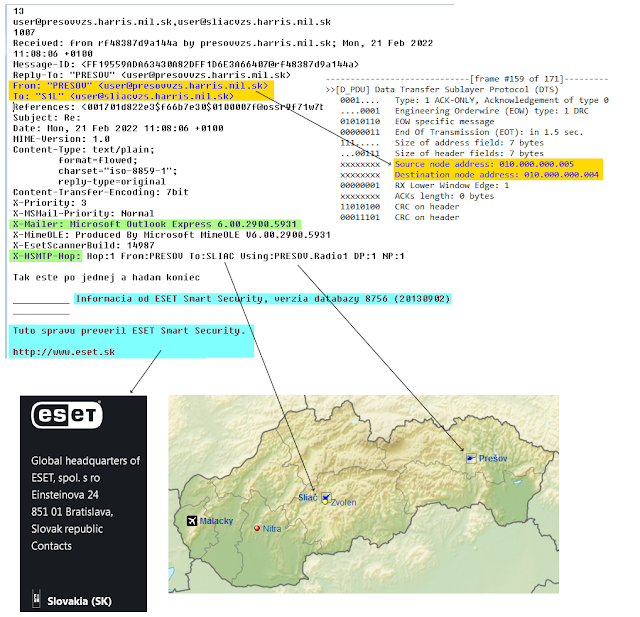
Slovakian AF communications spotted on Monday at 6343.0 KHz/usb, rather unusual frequency given the previous logs (actually first time heard on this qrg) and no more heard since last monday 21. The usual paradigm is used: ie, 188-141 2G-ALE handshake (S1L caller, P10 called) that is followed by the data forward by means of 188-110A ST modem and STANAG-5066 as datalink protocol.

Fig. 1 - STANAG-5066 bitstream

No transport protocol is used since STANAG-5066 assumes the burden of message integrity within the HF network: indeed, the email file are compressed and then transferred from one SMTP server to another by using HBFTP (Basic File Transfer Protocol) as per Annex F of STANAG-5066. BFTP implements a very simple end-to-end file transfer protocol based on the ZMODEM protocol and shall be provided by STANAG-5066 implementations: in this case, the initial "H" could stand for Harris implementation. It's to be noticed that BFTP is connected to the RCOP (Reliable-Connection-Oriented Protocol) socket interface.
HSMTP (likely Harris SMTP, Simple Mail Transfer Protocol) routing shows that the recipient node is at 1-hop distance (DP and NP values).
The email addresses and other terms reveal that the messaging system software, and most likely the connected radios, are provided by Harris Corporation, almost surely the Harris RF-67x0W Wireless Gateway suite. 

Fig. 2

about users:
ALE callsign P10 (Stanag-5066 address: 10.000.000.005) is "prezovvzs", Prezov VzS
ALE callsign S1L(Stanag-5066 address: 10.000.000.004) is "sliacvzs", Sliac VzS  
("Vzdušné Sily" is the Slovakian for Air Force)
It must be noted that for "domestic" traffic they do not use their S-5066 Regional Assignee range 6.42.y.z but rather 10.x.y.z.
Also interesting is the use of ESET Smart Security, database version 8756 (20130902), to protect the systems against virus and malware. 

https://disk.yandex.com/d/5kVfxb1Y95_R2Q

30 September 2021

analyzing the HF network traffic on 5120 KHz (OS BiH)


First of all I want to thank IZ6BYY Alain from Martinsicuro (Italy) who allowed me to use his KiwiSDR receiver without time limits: I very appreciated. 
I monitored this Bosnian HF network (I logged them first time on 2016) for more than two weeks: transmissions occur almost exclusively in the morning, not on weekends, and start around at 0730 UTC, likely following a certain schedule. The traffic consists of standards-based email exchange:

– 141A 2G ALE for link establishment
– Up to 2400 bps modem (Serial 110A, 39-tone 110A App.B)
– STANAG 5066 & CFTP client used for reliable over-the-air data delivery
– Standard SMTP email protocols into the wired network

All stations are members of the same ALE network and use the 3-way handshake for link management. In a few cases, a link closure similar to that used in STANAG-4538 is adopted, i.e. the link is terminated by the called station and not by the calling one.
The analysis of the 5066 PDUs after the removal of 110A overhead, figure 1, show the use of HBFTP compressed files (Harris Basic File Transfer Protocol) which, as for 5066 Annex F, is used along with CFTP for transfers from one SMTP server to another. 

Fig. 1 - STANAG-5066 PDUs showing the use of CFTP and HBFTP protocols

After HBFTPn.gz files have been extracted and unzipped, the email headers finally emerge and allow a bit of "intelligence" (figure 2):

Fig. 2 - email headers
 
wmtuser@OMEGA.ok, wmtuser@CIKLON.ok
The email addresses reveal that the messaging system software, and most likely the connected radios, are provided by Harris Corporation: indeed "wmtuser" is the email address default name that is prompted by Harris RF-67x0W Wireless Gateway. The ".ok" e-mail domain name stands for Operativna Komanda or Operational Command,
 
received: from osbihbutmir, received from kstbrvspvo
The server name "osbihbutmir" must be split as OS BiH Butmir where OS BiH (Oružane Snage Bosne i Hercegovine) stands for Armed Forces of Bosnia and Herzegovina, and Butmir is a neighborhood in Ilidža municipality site of the AF Operational Command HQ. Similarly, the name "kstbrvspvo" could be formed by the acronyms KSTBR and VSPVO, where KSTBR may stand for Communications Systems and Technologies Brigade (Komunikacioni Systems i Tehnologije BRigada).
I also noted the server name "jovana" which may have been chosen to honour the memory of Jovana Divjak, a Bosnian army general who died on April 8th, 2021: but that's just a my guess.

X-Mailer
The underlaying PCs run a Microsoft OS, likely Windows 2000 Professional or Windows XP Professional; Outlook 11 is used to draft and send the emails by OMEGA while other nodes seem to use Outlook Express.

X-HSMTP
(likely Harris SMTP, Simple Mail Transfer Protocol) The routing rows show that the recipient node is at 1-hop distance (DP and NP values).

By processing the bitstreams is then possible to derive the the 5066 addresses of the nodes and associate them to the related stations names and 141A ALE addresses  (in brackets):
 
000.000.000.001 OMEGA (OMA)
000.000.000.006 ASTRA (ASA)
000.000.000.007 CIKLON (CIN)
000.000.000.011 GRANIT (GRT)
000.000.000.016 LI(?)A (LIA)
000.000.000.017 LI(?)1 (LI1)
000.000.000.029 ORKAN (ORN)
 
It must be noted that:
1) the 5066 address range 0.0.0.0 — 0.255.255.255 does not have a Regional Assignee, rather the actual block allocation for Bosnia-Herzegovina is 6.6.y.z ( STANAG-5066 Annex N);
2) during the monitoring period I have not heard any other station or ALE address other than those listed. 
 
We also might compare the current station names with the old ones in use in year 2016, assuming that the 5066 addresses of the stations have not changed; notice that at that time the 141A ALE addresses were assigned  by using some popular automotive brands (HFMREZA is the Bosnian translation for HF Nerwork):

000.000.000.001 GAMAHFMREZA (GAMA)
000.000.000.003 FIATHFMREZA (FIAT)
000.000.000.005 FORDHFMREZA (FORD)
000.000.000.007 OPELHFMREZA (OPEL)        
000.000.000.009 SKODAHFMREZA (SKODA)   
000.000.000.011 VOLVOHFMREZA (VOLVO)        

Searching in the UDXF logs, this network appears for the first time in 2014: even in that case the ALE addresses were formed by the union of the first two and the last letter of the station names (TAO = TAngO), the latters consisting of the letters of the Greek alphabet: ALA (=ALFA), BRO (=BRAVO), DEA (=DELTA), GOF (=GOLF), EKO (=ECHO), OMA (=OMEGA), OSR (=OSCAR),TAO (=TANGO), ZUU (=ZULU).

The particular 5066 address (.001), the site (the AF Operational Command HQ), the traffic (OMEGA almost always initiates the ALE sessions) and the software too (Outlook 11 rather than Outlook express), led to think of OMEGA (OMA) as the net-control station as it was for the station GAMA. In addition to the change of station names and addresses, the most relevant change compared to 2016 is the paradigm used for emails: PEM - Privacy Enhanced Mail is now used for secure that traffic (figure 3).

Fig. 3
 
In some cases the contents of the emails are in clear-text, as for example the list of telegrams received/sent by the DK brigade (DK brTP) along with the greetings (*** Greetings from the team DK brTP OS BiH **** ) and the name of the operator of the "Workstation DK 6.pbr"; due to privacy, I have masked his surname:
 
Fig. 4

As said above, in some links the messages are also exchanged using the 39-Tone (110A App.B/FED-1052B) as HF waveform: this evidence proves the use of (at least) two radio networks where all or a subset of the nodes are members of both nets; at this regard, it's to be noted that Harris RF-6750 WG does not allow the use of multiple waveforms/protocols in a same radio-network. Likely, the HF email domain ".OK" coincides with only one radio network.
(yep I know, it's not good and it's definitely not discreet! anyway - to better illustrate my hypothesis - I had recourse to a old copy of the 6750 WG to simulate the software setup that I imagine and which in my opinion comes closest to the configuration which they use)

Fig. 5 - two distinct radio-networks with different waveforms/protocols

Another interesting point is that some bitstreams carried by the 39-tone and 188-110 modems have initial 41-bit length similar patterns (figure 6) that - in my opinion - reveal the use of encryption, therefore in those cases 5066 PDUs are not readable. I tried some analysis of the patterns and maybe they could be "partial" strings of the sequence generated by the polynomial x^42+x^41+x+1. 

Fig. 6 - 41-bit patterns in Serial 110A and 39-tone bitstreams

As far as the encryption device is concerned, my guess is that some links use Datotek encryption which is used in Harris RF-5022 and RF-5800 based radio stations. In that regard, I did some research in the web and found that as early as 2009 they were just using Harris RF-5022 transceivers during their participation as a PfP country in the "NATO Combined Endeavor" 2009 exercise (1). If my guess is correct, the 41-bit sequences could be a kind of "distinctive sign" of the Datotek encryption.

Fig. 7 - Datotek encryption may be used in RF-5022 based radio stations

https://disk.yandex.com/d/B0wHSW1Tfhz2Eg

(1) Bosnia and Herzegovina joined the Partnership for Peace (PfP) programme in 2006.At the beginning of 2021, Bosnia and Herzegovina established the Commission for Cooperation with NATO in order to facilitate the development of their Reform Programme for 2021-2022 and other matters on their path to accession.  
http://mod.gov.ba/Zdruzeni_napor/?id=21449 


16 November 2018

email over hf using FED-1052 DLP and "IDEA" encryption (2)

Yet another interesting catch of an email-over-hf session using FED-1052 Datalink Protocol (DLP, Appendix B) and IDEA encryption. The transmission was recorded on 09187.0 KHz/usb 1357z: encrypted MIL 188-141A 2G-ALE to set up links and switch to MIL 188-110A serial tone waveform for emal traffic via FED-1052 App.B DLP (Data Link Protocol); ASCII-7 data are encrypetd using CFB64 "IDEA" algorithm. Headers are unencoded so you can read both the sender and recipient, in this sample:
sender: ZJ1, root@bfzj1f1.is.bf.intra2.admin.ch
recipient: ZA1, statist@bf.intra2.admin.ch
email ID: "stat-ZJ1-20181113135501" (2018.11.13, time: 135501)
The FQDN (Fully Qualified Domain Name) "intra2.admin.ch" indicated in the e-mail addresses suggests an intranet of the central administration of the Swiss Federation: likely this is the Swiss Army or the Diplo Service.
A more detailed post about such transmissions can be read here.

Fig. 1 - on air signals, MIL 188-110A Serial Tone waveform
Fig. 2 - FED-1052 App.B stream