Showing posts with label OFDM-60. Show all posts

12 July 2018

MFSK-32 & OFDM 60-tone, a new "Serdolik" waveform ?


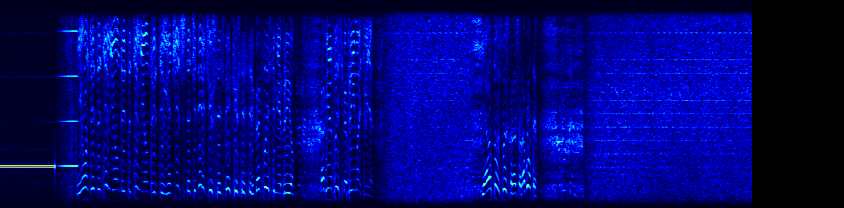
Interesting transmissions centered on 7659.0 KHz (7657.0/usb as tuning frequency) and picked up with a  KiwiSDR located in Northen Norway (Kongsdr).
Transmissions consist of MFSK-32 87Bd/97Hz and OFDM 60-tone 40Bd BPSK bursts, start and initial bursts likely act as  SOM/EOM and use a QPSK/PSK-8 2400 Bd modulation with 20ms ACF (ie 48 symbols). Both MFSK and OFDM bursts  are separated by 1900 ms and last 6000ms; the occupied bandwidth is about 3200Hz.
The OFDM bursts use the same MFSK-32 waveform as preamble and exhibit a clear 100ms CCF. Note the lack  of the usual 3300 Hz pilot tone. 
Likely it's a new waveform belonging to "Serdolik" family.

Fig. 1- MFSK-32 burts
Fig. 2 - OFDM 60-tone bursts
Fig. 3 - initial/final burst (SOM/EOM?)

The OFDM segment was observed also using QPSK modulation with a 225ms ACF

Fig. 4

Run a TDoA multilateration which showed Moscow area as the origin.

Fig.5


14 October 2015

CIS-60: just carriers


carriers only, w/out modulation, in this CIS-60 sample recordered at 14202.0 KHz on USB a fews days ago (added here beacuse of the signal strength). In that same listening-session, after the tone at ~850 Hz I listened to a short speech (in Russian language), a radio-check requested by the operator behind that CIS-60 (chizh-64) and directed the other side of the peer (neon-37): "neon 37 here chizh 64, how do you read me. Work, work" followed by data sending in CIS-60 data mode (translation from Russian by my good friend KarapuZ).
All recording files are available.


1 October 2015

CIS-60 30Bd, π/2-DBPSK

this CIS OFDM 60-tone modem, probably also it belonging to the CIS HDR family, was heard on 29 September at 0600z on 14259.0 KHz on USB. It exhibits a rather intriguing waveform:

1) manipulation speed is 30Bd and channel step 44.4Hz (Pic. 1), values are reasonably approximated since the signal was not sampled at its native frequency (look at "k" parameters);
Pic. 1

2) modulation format is DBPSK with these features: 
a) a service-tone (w/out modulation) is sent each 3 symbols in all (!) the carriers
b) 24 tones (say black-carriers) have π/2-DBPSK (Pic. 2);
c) 24 tones (say blue-carriers) have the same π/2-DBPSK modulation but with the evidence of the service tone (Pc. 3);
d) 12 tones (say red-carriers) have regular DBPSK (Pic. 4).

Pic. 2 - 24 (black) carriers: π/2-DBPSK
Pic. 3 - 24 (blue) carriers: π/2-DBPSK and service-tone
Pic. 4 -  12 (red) carriers: DBPSK
Pic.5 - phase angles in black/blue and red carriers

By writing the 60 coloured carriers in a 10x6 array, it's interesting to note that they are are arranged in a sort of diagonals format (Pic. 6):

Pic. 6 - carriers arrangement

About the ACF value, it is 200 ms, that makes 6 symbols although the real measure is 202.3 (Pic. 7) ms but you must consider that the signal is not perfectly in-frequency: infact the measured baudrate is not the expected 30.0 Bd but rather 29.9 Bd. Anyway, calculating the mathematical proportion:

(symbols-per-second : 1000) = (symbols : ACF)
(29.9 : 1000) = (x : 202.3) ; x = 6.04 

you get 6.04 symbols per frame. Then, given the exact 30Bd baudrate, I think the real ACF is 200. A further evidence in this direction is that just each 6 symbols the service-tone occupies the same position (Pic. 8).

Pic. 7 - 6 symbols ACF (200 ms)
Pic. 8 - each 6 symbols causes 200 ms ACF

14 August 2015

CIS-60 idle


The signal, heard on August 12.08 16810.0 KHz on USB, is a variant of the CIS-60 idle, possibly for test or adjustment/calibration purposes. CIS-60 waveform is analyzed here http://signals.radioscanner.ru/base/signal231/  and here CIS-60 in this blog.
I say a "variant" since a similar test signal is also mentioned in radioscanner.ru at that same address, but in my sample, at a first glance, looking at its sonogram the 60 tones seem to be housed in what looks like a curious 40+20 (+1 pilot tone) grid: although all the tones are not modulated, the top 20 tones (41-60) appear in some way shifted with respect to the lower ones (1-40). 
After resampled the signal at 8888.88 Hz (shift * 200), from 1-40 tone to tone there is a 180º phase shift in the relative constellation, but,from tone 40 to tone 41 there is no variation (Pic. 1). As AngazU too suggests, this could point to a different phase of the top 20 tones during the initial generation of the signal. Moreover, looking at the OFDM parameters (Pic. 2), there is a different baudrate in (at least this) test mode (30Bd) with respect to the usual traffic mode (35.5Bd). BTW, a 30Bd traffic mode was also noted.
Recordings available on request.

Pic.1 - phase variation

Pic. 2 - OFDM parameters

29 May 2015

CIS-60 HDR modem 35.5 Bd, π/8-DPSK8


CIS-60 is one of the Russian OFDM HDR (High Data Rate) Modem modes,  it uses 60 data carriers and 1 pilot carrier located 3300 Hz from dial frequency, as usual in CIS HDR modem series. According to my logs, CIS-60 comes in two waveforms (I have logged both the twos):
- Baudrate 30, modulation QPSK
- Baudrate 35.5, modulation π/8-DPSK8
in both the cases the carriers are 44.5 Hz spaced and the signals spreads a 2800 Hz bandwidth. Sometimes you could hear operators chatting (in voice) followed by a waveform switch, i.e. from DPSK-4 to DPSK-8: I do not know if it's for tests purposes or for some other reason. The original signal has been resampled to 8888.8 Hz.


radioscanner.ru reports CIS-60 DPSK-8 waveform here:
http://signals.radioscanner.ru/base/signal231/ 

25 March 2015

CIS-60 HDR modem 30 Bd, π/4-DQPSK

heard this morning on 14259.0 USB at 0720z, this is the second mode of the so-called "CIS-60" family: a CIS/Russian  OFDM HDR modem 60-tones + 1 pilot. 
Unlike the transmission heard yesterday, and reported in another post, the manipulation speed is 30 Baud per channel and modulation in channels is π/4-DQPSK; the channel separations remains at 44.44 hertz. I just would remember that the CIS-60 first mode is a π/8-DQPSK-8, 35.5 Baud mode.

Bandwidth: ~ 3000 Hz
Number of channels: 60 + 1 pilot tone (~ 3300 Hertz)
Manipulation in the channels: π/4-DQPSK
Step between channels (frequency net/grid): 44.44 Hz
Manipulation speed (Baud rate): 30