Showing posts with label FAB. Show all posts

28 February 2018

CARB-data formats in CTA, IDR, NSS, PBB and TBB transmissions

As a final stage of my ITA2 tour I wanted to take a look at how CARB (Channel Availability and Receipt Broadcast) data are sent. By the way, CARB transmissions typically consist of clear-text informations on the frequencies available for ship-shore traffic and are used to perform a channel-link before a message could be sent. 
Most stations (CTA, IDR, NSS, TBB) use STANAG-4285 600bps/Long while PBB uses asynchronous FSK 75Bd/850 for its CARBs; all the messages are originated in ITA2 (Baudot) and sent using the 5N1 framing.

Given the use of the 5N1 framing, a sharp 7-bit period bitstream is expected but it happens only in transmissions from IDR and NSS in which the start and stop bits are well identified and with clear-cut outlines (Figure 1)

Fig. 1
whereas in the other cases (CTA,TBB and PBB) bits are mixed up and a strict 5N1 format is impossible to see (Figs 2,3)

Fig. 2
Fig. 3

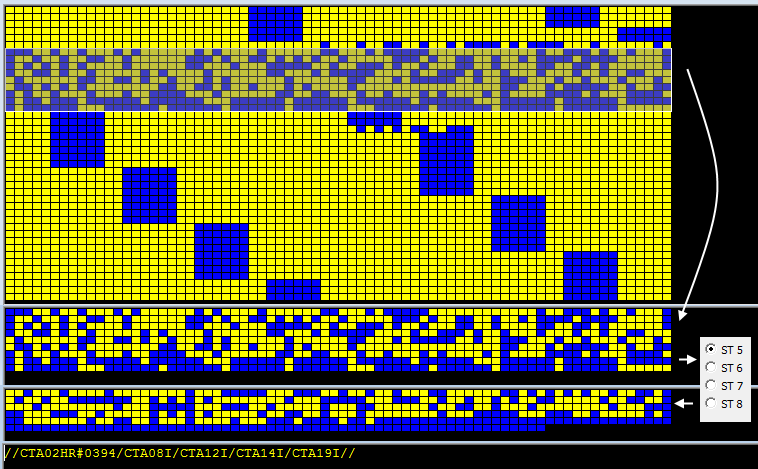
In TBB transmissions the CARB data are sent within a 75-bit frame, with a variable spacing between the ITA2 characters (spaces consist of 1-value bits). It's just the variable spacing that makes clear 5N1 visualization impossible. To clean up the bitstream and remove the start and stop bits I used the "Del CT" tool provided by the BEE software, "Del CT" can be used to extract a character length of 5,6,7,8 bits (ITA2 and ITA5): in this case I used the "5 bit" setting. The tool searches and removes the framing, returning the initial ITA2 characters of the CARB strings (Fig. 4)

Fig. 4
The same procedure was used for CTA transmissions, in which the CARB frame length is 74 bits (Figure 5).

Fig. 5
Unlike the above, IDR and NSS use a fixed spacing between the characters and this allows the clear 5N1 visualization depicted in Figure 1 (a perfect 7-bit period frame).

Fig. 6
In cases like this it is not necessary to use the "Del CT" tool and the start and stop bits can be removed by hand (figure 7).

Fig. 7
The CARB transmissions from PBB, although they use asynchronous FSK and not the S-4285 waveform, adopt the same way of TBB and CTA: data are sent within a 64-bit frames and with variable spacing between characters. The five ITA2 bits are recovered from the demodulated bitstream by using "Del CT" tool (Figure 8).

Fig. 8

And... don't be fooled by your eyes: bits are sent serially from left to right and row by row!

Fig. 9

24 August 2014

CARB messages

CARB is the acronym for Channel Availability and Receipt Broadcast, these transmissions radiate information on the frequencies available for ship-shore traffic and to pass control and receipt messages; sometimes also indicated as FAB or Frequency Availability Broadcast. Some naval stations use both RTTY and STANG-4285 for CARBs, sometimes interspersed with pseudo-random encrypted data (see CTA CARBs).

CARB procedures are used to automatically perform a channel-link before a message could be sent.
A number of receivers ashore are combined to omni-directional aerials, the frequencies being those advertised on the CARB. A ship wishing to send a message raises a transmitter on the optimum frequency available and send a test message. This message includes an indication of the ship's position with reference to the directional aerials available to the receivers ashore. The shore station selects the best directional aerial to receiver and acknowledges the receipt of the test message by a condition code on the CARB transmission. A second test message from the ship measures the quality of reception and requests transmission of traffic. The ship then passes its traffic, receiving recepits on the CARB until its traffic is cleared. The shore station then returns his receiver to an omni-directional aerial and resets the CARB.

Some CARBs examples (the ending "I" usually stands for I(N) IDLE)

CTA NATO Lisbon, POR (STANAG-4285)
1924Z//CTA04I/CTA08I/CTA12I/CXTA14I//
1933Z//CTA02I/CTA04I/CTA08I/CTA12I/CTA14I//
2145Z//CTA02I/CTA04I/CTA06I/CTA08I/CTA12I//

PBB Dutch Navy Den Helden, HOL (RTTY 75/850)
02A 04B 06A 08B 12A 16X PBB
04O 06A 08B 12A 16X 22X PBB 

IDN Nato Allied Joint Force Command Naples, I (STANAG-4285)
//NSS1I(0)//
//NSS1I(0)//
//NSS1I(0)//

IDR/IGJ Italian Navy Rome, I (STANAG-4285)
IDR2 /IGJ42 /IGJ43 /IDR8 /IDR3 /IGJ41 /

In this real-world CTA message (courtesy by Wolfgang from UDXF) they QSL #3849
1259Z//CTA02I/CTA06OR#3849/CTA08I/CTA12I/CTA14I//
and the QSX seems to be on 6 MHz (CTA06)
Some CARBs transmissions heard at my side
PBB CARB transmission

IDN CARB transmission

CTA CARB transmission


IDR Rome CARB transmission
TBB Turkish Navy Ankara, CARB Transmission

CTA/CTP CARB transmission