30 March 2023

S-4538/110A transfers using 256-bit Initialization Vectors (2)

Recently I analyzed an interesting recording sent me by my friend Mike (mco) some days ago; for clarity, the transmission was recorded on 8006 KHz/USB. As shown in Figure 1, the recording consists of four data segment sent using the 188-110A Serial Tone (at 600bps/S), two 188-141B async call PDUs ("obsoleted", 3G-ALE)(1) and a final FLSU (Fast Link SetUp) PDU that terminates the link, the latter BW5 waveform suggests a STANAG-4538 3G-HF "circuit mode service" transmission, as well as the use of the 141B async call suggests the use of Harris equipments.

Fig. 1

The bitstream after 110A removal (Figure 2) clearly shows the use of encrypted frames which are characterized by the use of 256-bit length Initialization Vectors (IVs), thus the data-link protocol is also encrypted (not the data only). It's to be noticed that each Initialization Vector is 8 times repeated.
 
Fig. 2

The frame structure appears almost the same of the one analyzed in a similar transmission analyzed some times ago [1], in that case the 110A modem was used at 2400 bps/S. Studying more closely the four bitstreams, it's possible to see recurrence of a same COMSEC preamble consisting of 01s sequences for bit phasing, same repeated sequences (probably for frame sync), and obviously the four different 256-bit length Initialization Vectors (Figure 3).
 
Fig. 3

phasing

223-bit sequence sync:
0101101111011010010000100011110110111101110000100100001111000100010111011010001110100101101110111
1011100001001000011110001000101110000100011101001011011101111011100001001000011110001011010001001
00001110111101101000100011110

256-bit Initialization Vectors, each 8 times repeated:
E7 F6 45 FD 63 53 2A 4B 91 0B 0E B7 A8 80 00 00 
63 35 D7 73 64 9B 8D 08 35 3F 26 0D 9D BE 02 F9 

D7 32 3B 83 D0 6F 57 03 A9 65 CA F7 64 64 00 00
9B 32 8E B9 2B D0 9D D6 00 FB 96 53 68 92 BD F5 

87 32 AA F0 9C 3D 03 EE E2 00 26 EF 45 4D 00 00 
82 8F C3 CC BF 2B 36 99 51 27 45 88 9D 83 2E F7 

77 CD 93 E5 EB AF 65 3D B6 2B 1A 47 4E 19 00 00
C6 E1 5C FA 8B 16 57 57 0E 2B 04 C9 65 66 25 F3

phasing

32-bit sequence sync (6 times repeated):
8B 87 84 7B

The COMSEC preamble is followed by encryption, according to the standard MIL 188-220D [2].

Fig. 4
 
For what concerns the encryption, I would speculate the use of "HC-256", a software stream cipher for embedded systems which generates keystream from a 256-bit secret key and a 256-bit Initialization Vector [3], but it's just a guess.

 
(1) 188-141B (released on March 1999!) was superseded by 188-141C (December 2011), in its turn superseded by 188-141D (December 2017): the last two standards no longer have the Appendix C but only some short paragraphs, among them the #C.6 says "The specifications previously contained in this appendix have been replaced with reference to the essentially identical NATO STANAG 4538". 

[1] https://i56578-swl.blogspot.com/2020/09/s-4538110a-transmissions-using-unid-256.html
[2] http://everyspec.com/MIL-STD/MIL-STD-0100-0299/MIL-STD-188-220D_CHG_NOTICE-1_24817/ 
[3] https://www.ecrypt.eu.org/stream/ciphers/hc256/hc256.pdf 

15 March 2023

unid 188-110A transmissions... and equally curious bitstreams

Some interesting transmissions were noticed last weekend on 5074.20 KHz/USB, transmissions consisting of continuous blocks of different durations and sent using the standard MS-110A modem with a fixed data rate of 1200 bps/S. Judging by the intensity of the signals and the fading patterns shown in the FFT-Spectrum, the transmissions were one-sided, ie PtP or PtMP (like a broadcast style).

Fig. 1

Analyzing the resulting bitstream after the demodulation of the signals, surprisingly, it can be noted that one bit is replaced by 16 bits during the reversals section (Figure 2).

Fig. 2 - 16-bit stream

However, looking more closely, it can be stated that the 1->8 replacement is adopted during the traffic period, i.e. each data bit is sent 8 times (Figure 3).

Fig. 3 - 1to8 bit replacement during traffic period

In order to get some more information, I reshaped the bitstreams to a 8-bit format and then removed the 7 extra bit columns: as you can see in Figure 4, not all the single transfer sessions have a same period, indeed it may vary from 91 to 111 bit. 

Fig. 4

Also, for some reason that I do not know, there are very few single bits of information, just pairs 11s or 00s; just for a try I arbitrarily replaced the pairs with  single bits of the same value: the resulting stream, after the removal of the reversals sections, shows 60-bit patterns. I also tried the differential decoding but I didn't get any other interesting results about the nature of the data and the used transport protocol. My friend cryptomaster, who too heard and analyzed that transmissions, got the same results.
The working frequency (5074.20 KHz/usb) is not among those known or at least it is not reported on the UDXF logs, and given that the transmissions have not been repeated and the strange characteristic of the bitstreams, it could also be test transmissions.
What is certain is the geographic area where the Tx site is located: all the direction finding tries (TDoA method) point to the state of Lower Saxony, Germany (Figures 5,6).

Fig. 5

Fig. 6

I just want to report that a similar stream has been noted in some STANAG-4285 transmissions [1]: maybe these "expansions" are used to add redundancy and then increase the reliability of the channel, although HF protocols use their own FEC encoding.

https://disk.yandex.com/d/QgDFohyS8dqeVg

[1] http://i56578-swl.blogspot.com/2022/01/an-odd-16-times-expanded-5n1-framing-uk.html?m=0

13 March 2023

RapidM proprietary WB-LDL & WB-RDL waveforms (2)

Thanks to a nice catch by my friend ANgazu from radiofrecuencias.es, who I thanks, it's now possible to add two other waveforms (#9, #11) to the Table II of the previous post [1]. The waveforms belong to the "120 ms frames" family, respectively 30 KHz bandwidth 24000 Bd (WF #9, Figure 1) and 42 KHz bandwidth 33600 Bd (WF #11, Figure 2).

Fig. 1 - 30KHz/24000Bd waveform

Fig. 2 - 42KHz/33600Bd

https://disk.yandex.com/d/o8htpYuX7xSXuw

[1] https://i56578-swl.blogspot.com/2022/12/wale-wideband-traffic-probably-rapidm.html


23 February 2023

unid "mixed-mode" transmission

 updated

 Very interesting "mixed-mode" transmission cathced and sent me by by friend Michel (F1GOC)

Fig. 1

Segment 1 consists of an FSK modulation keyed at 200 Baud and 1000 Hz shift (Figure 2). The demodulated bitstream has a well defined period of 288 bit consisting of a data segment preceded/followed by a sync/probe sequence (Figure 3).

Fig. 2
 

Fig. 3

Segment 2 consists of an MFSK-7 modulation keyed at 30 Baud and 400 Hz separation between the tones. The raw demodulation of the seven tones (0-6;000-110) shows a repeated sequence of 940 bit length (Figures 4,5).

Fig. 4

Fig. 5

Segment 3 is the most interesting one. This segment consists of 7 subcarriers which coincide with the tones of the previous MFSK segment (see Figure 1), the modulation used for each subcarrier - in my opinion - seems to be ASK2/OOK. The "aggregate" speed of modulation is 200 Baud, ie 28.5 Baud per channel (Figure 6). The autocorrelation function of the signal shows a period of 10 seconds, corresponding to 2000 bit frames (Figure 7).

Fig. 6

Fig. 7

As a simple curiosity, the central frequency of the FSK segment does not coincide with the value of the center band of the following two segments (see Figure 1). Difficult to state the user and the purpose of the transmission, many "experimental" signals are in the air especially during this period, comments are welcome.

------- update  --------------------------------------------------------

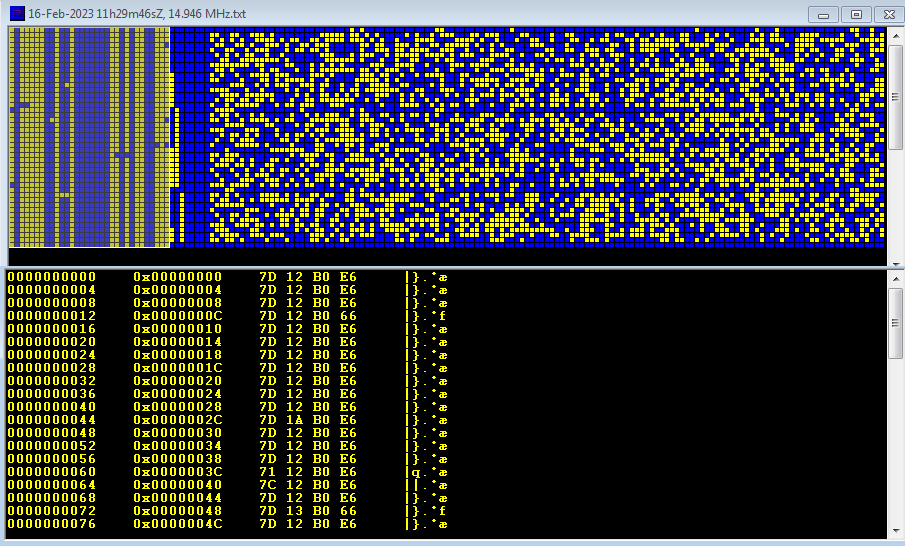
As my friend cryptomaster commented (and my friend Nicola too in pvt), the FSK segment is the well-known Russian Intel "F06" waveform. Indeed, after the change of the bit-order is possible to clearly see the typical F06 32-bit sync sequence 7D12B0E6 (Figure 8). The final part of the decoding, thanks to the rivet_b90 tool, is shown below (Figure 9). 

And... yes, I'm a bit out of shape since the 288-bit period should have suggested the solution 😁

Fig .8 - F06 sync sequence
 

Fig. 9 - F06 decoding

https://disk.yandex.com/d/2hsIqrswtSwzHw

1 February 2023

unid ASK2/OOK transmissions

updated

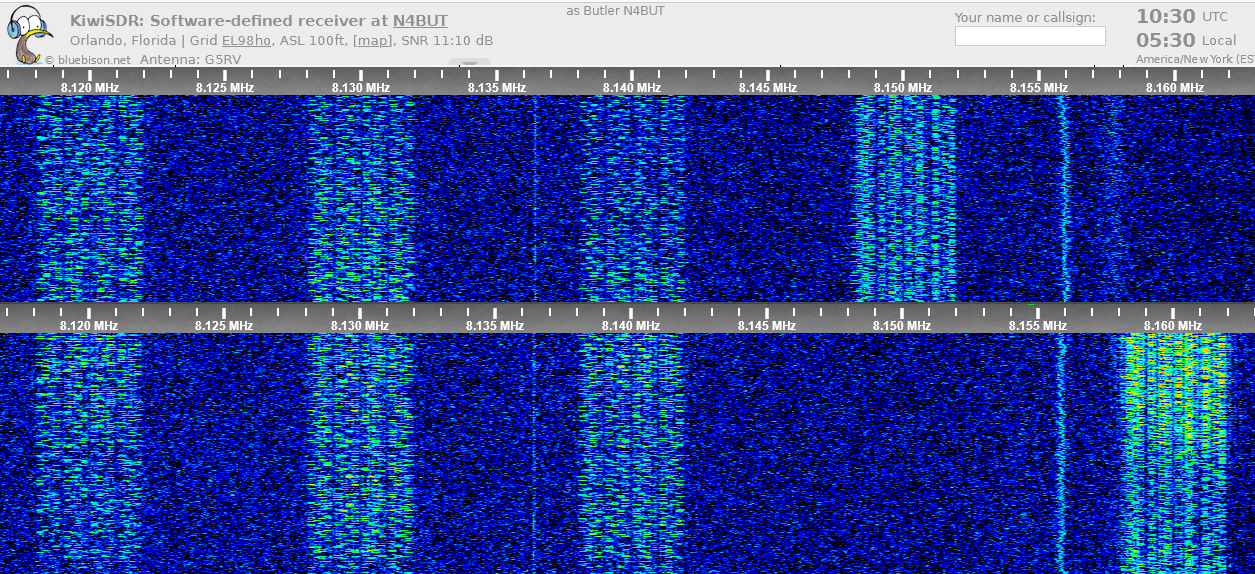
Unid transmissions heard on 8120, 8130, 8140, and 8150 KHz (the latter moved to 8160 Khz) thanks to the KiwiSDR located at N4BUT Orlando, FL [1].

Fig. 1

At first sight the signal seemed a MPSK modulation, but working the signal along with my friend cryptomaster some other interesting features came out. Each transmission consists of four 100 Hz separated channels (a,b,c,d) each occupying a band of about 900 Hz, for a total bandwidth occupation of about 3900 Hz (Figure 2).

Fig. 2

In turn, each of the 4 channels consists of 4 sub-channels with a modulation rate of 49.6 Baud, the used modulation seems to be ASK2/OOK [2].

Fig. 3

Each of the four sub-channels shows strong ACF peaks of 1290 ms corresponding to a 64-bit length frame: the "aggregate" frame therefore has a length equal to exactly 1 Kb, ie 1024 bits or 128 bytes (64x4x4).

Fig. 4

Below in Figure 5 is a comparison of the four channels obtained from the analysis of my friend cryptomaster.

Fig. 5

Although I have kept an eye on that initial portion of the 8 MHz band (fixed/mobile band, shared with marine for simplex purposes), those transmissions have not appeared again (at least until today): difficult to define their purpose and user(s).

Below the interesting comment sent me by my friend Nicola, who I thanks for the collaboration:

"The interesting signal discussed in the blogpost “Unid ASK2/OOK transmissions” dated 1 February is probably a Frequency-Time Matrix (FTM) system, where a data symbol (bit string) is represented by FT-matrices, i.e. combinations of frequency and time domain positions. The 'secret' of this robust mode is that no frequency is repeated within each matrix. This characteristic is used to enhance the resilience against frequency domain broadband noise (or fading) affecting a broad range of frequencies and time domain narrowband noise (or fading)." 

https://disk.yandex.com/d/7u74pzY-bPntXg

[1] http://sdr.n4but.com:8173/?f=8120.00iqz10&pbw=10000
[2] https://en.wikipedia.org/wiki/Amplitude-shift_keying