8 January 2016
2 January 2016
HFDL Ground Stations (traffic to and from)
tags:
HFDL
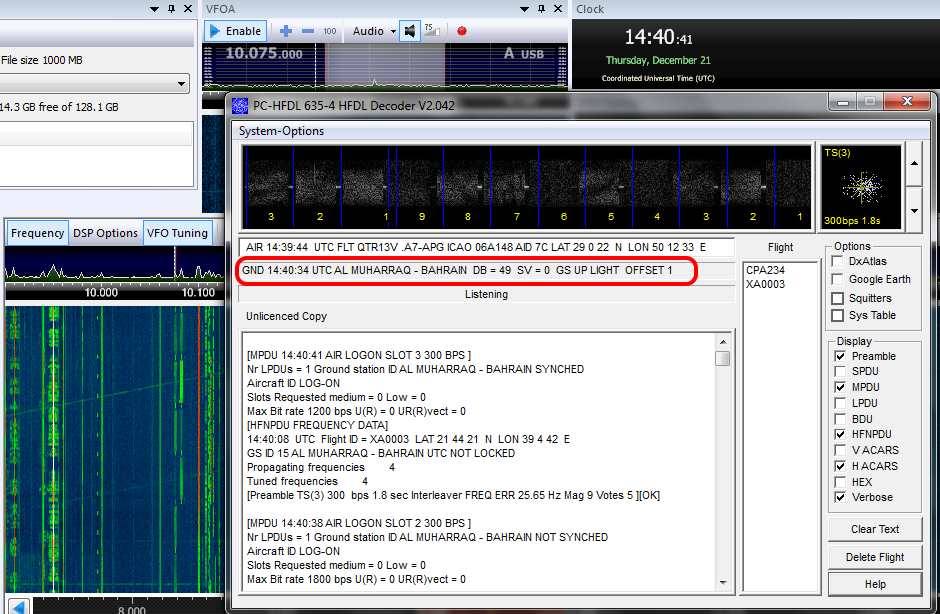
HFDL (High Frequency Data Link) is a HF data link protocol, defined in ARINC spec 635-3.It may be described as some sort of HF ACARS. It's used to exchange data such as Aeronautical Operational Control (AOC) messages, Controller Pilot Data Link Communications (CPDLC) messages and Automatic Dependent Surveillance (ADS) messages between aircraft end-systems and corresponding ground-based HFDL ground stations.
Transmissions on HF are in USB on a sub carrier of 1440 Hz with a symbol speed of 1800 baud. Modulation is 2-PSK, 4-PSK or 8-PSK with effective bit rates of 300, 600, 1200 or 1800 bits/sec.
The HFDL service is operated by ARINC as GLOBALink service through a worldwide network of HF stations.
Ground Station ID 1
SAN FRANCISCO - CALIFORNIA
Longitude 121 45 34 W Latitude 38 22 48 N
Ground Station ID 2
MOLOKAI - HAWAII
Longitude 157 10 46 W Latitude 21 10 47 N
SAN FRANCISCO - CALIFORNIA
Longitude 121 45 34 W Latitude 38 22 48 N
Ground Station ID 2
MOLOKAI - HAWAII
Longitude 157 10 46 W Latitude 21 10 47 N
Ground Station ID 4
RIVERHEAD - NEW YORK
Longitude 72 38 22 W Latitude 40 52 47 N
RIVERHEAD - NEW YORK
Longitude 72 38 22 W Latitude 40 52 47 N
Ground Station ID 5
AUCKLAND - NEW ZEALAND
Longitude 174 48 35 E Latitude 37 1 10 S
Ground Station ID 6
HAT YAI - THAILAND
Longitude 100 23 24 E Latitude 6 56 23 N
Ground Station ID 7
SHANNON - IRELAND
Longitude 8 55 46 W Latitude 52 43 48 N
Ground Station ID 8
JOHANNESBURG - SOUTH AFRICA
Longitude 28 12 35 E Latitude 26 7 46 S
Ground Station ID 9
BARROW - ALASKA
Longitude 156 46 46 W Latitude 71 18 0 N
Ground Station ID 11
ALBROOK - PANAMA CITY
Longitude 79 32 59 W Latitude 8 58 12 N
Ground Station ID 14
KRASNOYARSK - RUSSIA
Longitude 92 18 0 E Latitude 56 6 0 N
Ground Station ID 13
SANTA CRUZ - BOLIVIA
Longitude 63 7 46 W Latitude 17 40 11 S
Ground Station ID 16
AGANA - GUAM
Longitude 144 48 0 E Latitude 13 28 11 N
Ground Station ID 15
AL MUHARRAQ - BAHRAIN
Longitude 50 39 0 E Latitude 26 16 12 N
Ground Station ID 17
CANARIAS - SPAIN
Longitude 15 23 23 W Latitude 27 56 59 N
20 December 2015
pseudo-random frequency hopping
tags:
FHSS
Frequency Hopping Spread Spectrum (FHSS) is a method of transmitting radio signals by rapidly switching the carrier among many frequency channels using a pseudo-random sequence known to both transmitter and receiver(s). The heard packets in this sample have a duration of 2520 ms, frequency shift ~ 20 Hz and 20 data bits carried (other similar transmission have been noted with 2460 ms and 24 data bits, same shift) and span up a 2 MHz bandwidth, this recording has been on 13 MHz band.
![]() |
12 December 2015
playing with MS-DMT (MIL-STD Data Modem Terminal)
tags:
MS-DMT
The MS-DMT application is a software defined modem based communications terminal tool developed as a Microsoft Foundation Class (MFC) based Multi-threaded 32 bit application. It is currently designed to run under MSWindows XP SP3 and later versions of both 32 and 64 bit MS-Windows operating systems. The tool is written in C++ using the Microsoft Visual Studio 2008 compiler and requires the installation of the VS2008 C++ runtime redistribution libraries which are part of the full MS-DMT install distribution only.
The MS-DMT tool functions as both a MIL-STD modem and basic data communications terminal and provides MARS a MIL-STD-188-110A (MS110A) compliant Serial Tone (ST) waveform modem based Message Terminal capability providing message composition and automated message storage to simplify MARS MS110A Forward Error Correction (FEC) message handling.
The software’s terminal provides numerous features to aid in message handling and the software also supports the use of more fully featured external asynchronous terminal applications. Additional features such as Data Link Protocol, Data Compression, Data Encryption and others may be added to the MS-DMT tool as required and in accordance with the specific standards as requested or left to implementation in external terminal applications.
You may use MS-DMT to build, decode and learn the MIL-STD 188-110 ST wavefvorm, the modem, along with other interesting resources and docs, can be downloaded from here:
MIL-STD Data Modem Terminal (MS-DMT) software and resources
3 December 2015
MFSK-4 (double FSK) 96/100Bd 500Hz, Ukraine Military
tags:
F7B,
F7W,
MFSK waveforms,
Ukraine-nets
This waveform is known as Double FSK 96/100 Baud and 500 Hz shift, a dual channel mode used by Ukraine Military, spreading about a 1730Hz bandwidth and tones at -750, -250, +250 and + 750 Hz. Actually, there are two versions of this waveform:
96Bd-100Bd/500 heard on August 21th on 8008 KHz/usb (likely F7W mode?)
96Bd/500 heard on December 3rd on 6968 KHz/usb (F7B mode)
Site radioscanner.ru reports the first signal (08/21) as Ukraine Mil 96-100, the two baudrates indication (96 and 100) is due to some difficulties in determining the speed of manipulation, due to the fact that the two transmission channels are not synchronized with each other. The "double" speed is not present in the measurement results of the first signal (12/03): most likely the two channels are in sync and transmitted according to the F7B mode.
96Bd-100Bd/500 waveform (likely F7W mode?)
https://yadi.sk/d/SvmC1_ajzVzAAw
96Bd/500 waveform (F7B mode)
https://yadi.sk/d/VHJYHLgg7ATdeA
96Bd-100Bd/500 heard on August 21th on 8008 KHz/usb (likely F7W mode?)
96Bd/500 heard on December 3rd on 6968 KHz/usb (F7B mode)
Site radioscanner.ru reports the first signal (08/21) as Ukraine Mil 96-100, the two baudrates indication (96 and 100) is due to some difficulties in determining the speed of manipulation, due to the fact that the two transmission channels are not synchronized with each other. The "double" speed is not present in the measurement results of the first signal (12/03): most likely the two channels are in sync and transmitted according to the F7B mode.
| Fig. 1 |
| Fig. 2 |
https://yadi.sk/d/SvmC1_ajzVzAAw
96Bd/500 waveform (F7B mode)
https://yadi.sk/d/VHJYHLgg7ATdeA
Subscribe to:
Posts (Atom)